
Minimum wage by state over time
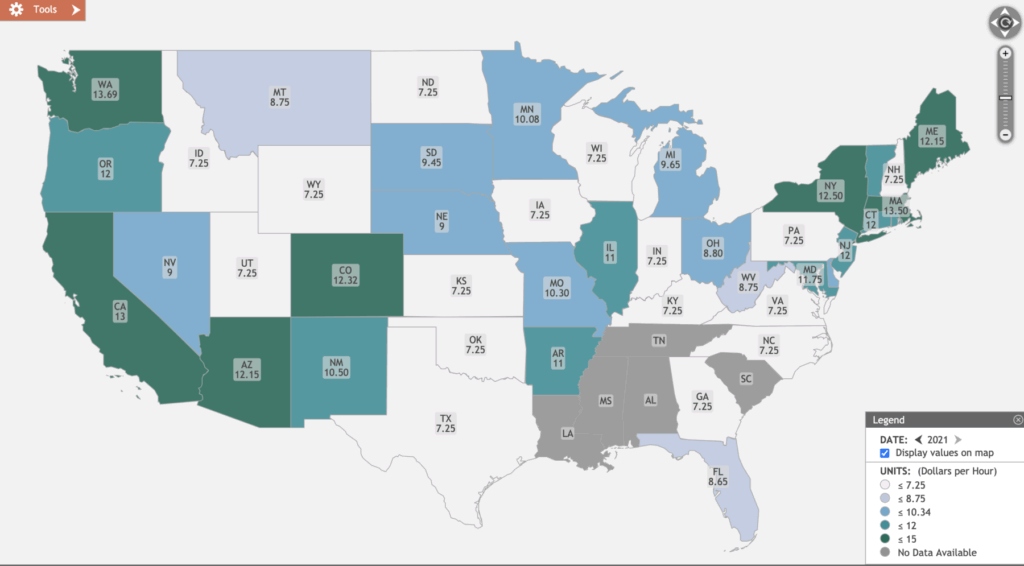
The minimum wage by state over time reflects a complex and evolving landscape across the United States. While the federal government sets a baseline, individual states have the authority to establish higher rates, leading to significant regional disparities. Over the past several decades, economic pressures, cost of living differences, and policy priorities have driven states to adjust their minimum wages independently.
Some states have consistently led the way with above-average rates, while others rely solely on the federal standard. Tracking these changes reveals patterns linked to inflation, labor movements, and political shifts, offering critical insights into wage equity and economic policy across time and geography.
Minimum Wage by State Over Time: A Historical and Regional Perspective
The evolution of the minimum wage by state over time reflects a complex interplay of economic conditions, political priorities, and regional cost-of-living disparities across the United States.
 2023 minimum wage by state
While the federal government sets a baseline federal minimum wage, individual states have the authority to establish higher rates, and many have done so in response to rising living expenses and labor advocacy. Since the inception of the federal minimum wage in 1938 under the Fair Labor Standards Act (FLSA), the national rate has increased intermittently, but with growing criticism for failing to keep pace with inflation.
Over the past few decades, a widening gap has emerged between states, with coastal and urban states like California and Washington consistently setting aggressive timelines to reach $15 per hour, while others adhere to—or even fall below—the federal standard. This divergence underscores how localized economic realities shape wage policy and contribute to significant variation in workers’ earning potential depending on geography.
Historical Development of State Minimum Wages
The trajectory of state-level minimum wages has evolved dramatically since the mid-20th century, beginning with a uniform reliance on the federal floor.
However, as inflation eroded the purchasing power of the federal rate—last raised to $7.25 in 2009—states began asserting greater control over wage standards. Pioneering states like Oregon and Washington implemented indexed increases tied to inflation as early as the 1990s, setting a precedent for automatic adjustments.
 Minimum wage by state and year
Over time, cities and states with high costs of living, such as New York, California, and Massachusetts, enacted legislation to incrementally raise minimum wages toward $15 per hour, a movement popularized by the Fight for $15 campaign beginning in 2012.
These actions not only lifted wages for millions but also pressured neighboring states to reconsider their own policies, creating a patchwork of rates that highlight the decentralization of labor standards in the U.S.
Current Variations in Minimum Wage Across States
As of 2024, minimum wage rates across the U.S. vary significantly, ranging from the federal baseline of $7.25 per hour to $16.56 in Washington, D.C., and $16.00 in Washington state.
Twenty-nine states and the District of Columbia have minimum wages above the federal level, with several adjusting annually for inflation. States like Alabama, Mississippi, and Tennessee have no state minimum wage law, defaulting to the federal rate, though employers subject to the FLSA must still comply.
 Minimum wage by state by year
Meanwhile, states such as Florida and Illinois have legislated gradual increases, with Florida moving to $13 in 2024 and aiming for $15 by 2026. This landscape reflects a growing recognition that a one-size-fits-all federal rate fails to address regional cost-of-living differences, prompting states to tailor wage floors to their unique economic environments.
Impact of Inflation and Cost of Living on State Wage Policies
In recent years, inflation and escalating cost of living have become central drivers behind state-level minimum wage increases. With housing, healthcare, and childcare costs rising faster than wages in many areas, workers earning the federal minimum wage often fall below the poverty line.
In response, states like California and New York have not only raised base wages but also implemented automatic cost-of-living adjustments (COLAs) to preserve wage value over time. These indexed increases, typically tied to the Consumer Price Index (CPI), help mitigate erosion in real income and provide predictability for both workers and businesses.
The focus on inflation-adjusted wages signifies a shift from reactive, politically-driven changes to proactive, data-informed policy, aiming to ensure that minimum wage workers can afford basic necessities in their local economies.
 Minimum wage by state us
| State | Minimum Wage (2024) | Federal Minimum Wage | Notes |
|---|---|---|---|
| California | $16.00 | $7.25 | Indexed to inflation; higher in some cities like San Francisco ($18.07) |
| Washington | $16.28 | $7.25 | Highest state rate; adjusted annually for inflation |
| New York | $15.00–$16.00 | $7.25 | Varies by region; NYC has highest rate |
| Florida | $12.00 | $7.25 | Increases annually; to reach $15 by 2026 |
| Texas | $7.25 | $7.25 | Follows federal minimum; no state law |
| Alaska | $11.73 | $7.25 | Adjusted annually for inflation |
| Mississippi | $7.25 | $7.25 | No state minimum wage law |
Frequently Asked Questions
What is the federal minimum wage in the United States?
The federal minimum wage in the United States is $7.25 per hour, established in 2009. This rate applies nationwide, but individual states can set higher minimum wages. When state and federal rates differ, employees are entitled to the higher of the two. Some local jurisdictions also have their own minimum wage laws that may exceed both state and federal levels.
How do state minimum wages change over time?
State minimum wages change through legislative updates, voter initiatives, or automatic cost-of-living adjustments. Many states index their minimum wage to inflation, leading to annual increases. Others pass new laws periodically based on economic conditions or political decisions. Changes typically require approval from state legislatures or ballot measures, and employers must comply once the new rates are officially enacted and announced.
Which states have the highest minimum wage rates?
As of 2024, states like California, Washington, and Massachusetts have some of the highest minimum wages, exceeding $15 per hour. Washington, D.C. has the highest rate at over $17 per hour. These rates are often adjusted annually for inflation. States with high costs of living are more likely to implement higher minimum wages to help workers meet basic expenses.
Can a state’s minimum wage be lower than the federal rate?
Yes, a state’s minimum wage can legally be lower than or equal to the federal rate. However, the Fair Labor Standards Act mandates that workers receive the higher of the two rates. In practice, if a state’s minimum wage is below the federal rate of $7.25, employers must still pay the federal minimum. Most states either match or exceed the federal standard.
Leave a Reply