
How many undocumented workers in florida
The exact number of undocumented workers in Florida remains uncertain due to the nature of their status, but estimates suggest hundreds of thousands reside and work in the state.
These individuals contribute significantly to key industries such as agriculture, construction, and hospitality, often filling essential labor gaps.
While comprehensive data is challenging to obtain, research from organizations like the Pew Research Center indicates that Florida hosts one of the largest undocumented populations in the United States.
 How many undocumented workers
Understanding the scope and impact of this workforce is critical for policymakers, business owners, and communities navigating economic, social, and legal considerations surrounding immigration in the state.
How Many Undocumented Workers Are in Florida?
Estimating the exact number of undocumented workers in Florida involves analyzing data from government agencies, academic research, and demographic studies.
While precise figures are difficult to determine due to the undocumented status of these individuals, reputable sources such as the Pew Research Center and the Migration Policy Institute provide estimates based on census data, labor force surveys, and immigration trends.
As of recent analyses, it is estimated that there are approximately 650,000 to 750,000 undocumented immigrants living in Florida, a significant portion of whom are part of the state’s workforce. These individuals are employed across various industries, including agriculture, construction, hospitality, and domestic services.
 How many undocumented workers are there
Florida's proximity to the Caribbean and Latin America, as well as its large agricultural sector, contributes to the presence of a substantial undocumented labor force. The lack of federal documentation prevents many from accessing formal labor protections, yet their economic contributions remain significant.
Methods Used to Estimate Undocumented Worker Populations
Researchers use a residual estimation method to determine the number of undocumented immigrants and workers in the U.S., including Florida.
This method involves subtracting the number of legally present immigrants—based on visas, green cards, asylum status, and naturalization—from the total foreign-born population counted in U.S. Census Bureau surveys such as the American Community Survey (ACS).
Adjustments are made for census undercounts and data on legal status obtained through surveys. The Migration Policy Institute and Pew Research Center are among the leading organizations that apply this method consistently.
 How many undocumented workers in agriculture
For Florida, this approach indicates that undocumented immigrants make up roughly 4% to 5% of the total state population, with labor force participation rates comparable to or higher than those of native-born workers. These estimates, while not exact, are widely accepted among policymakers and researchers.
Industries That Rely on Undocumented Labor in Florida
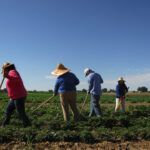
Undocumented workers play a critical role in several key sectors of Florida’s economy. In the agricultural industry, especially in regions like Immokalee and Belle Glade, undocumented laborers harvest citrus, tomatoes, strawberries, and sugarcane—crops vital to the state’s $8 billion agricultural sector.
The construction industry also depends heavily on undocumented labor, particularly in fast-growing metropolitan areas such as Miami, Orlando, and Tampa, where demand for housing and infrastructure is high. Additionally, the hospitality and service sectors, including hotels, restaurants, and cleaning services, employ a notable number of undocumented workers.
Employers in these industries often cite a shortage of local labor willing to take low-wage, physically demanding jobs. However, this dependence creates vulnerabilities, as these workers often lack formal contracts, health benefits, or protections from workplace exploitation.
 How many undocumented workers are there in the us
Demographic and Geographic Distribution in Florida
The undocumented population in Florida is ethnically diverse, with the majority originating from Mexico, Central America (particularly Guatemala, Honduras, and El Salvador), and the Caribbean (especially Haiti and Cuba).
Many settle in urban centers where immigrant communities and support networks already exist. Miami-Dade County has the largest concentration of undocumented immigrants, followed by Orange, Hillsborough, and Palm Beach Counties.
Language, community organizations, and religious institutions often serve as integration resources. While some undocumented individuals arrive through visa overstays—especially from countries outside Latin America—others cross the southern border or arrive by sea.
The population includes both long-term residents who have lived in Florida for decades and more recent arrivals. This geographic and demographic dispersion highlights the complexity of immigration patterns and the integration of undocumented workers into local economies.
 How many undocumented workers in texas
| Estimate Source | Estimated Undocumented Population in Florida | Year of Estimate | Primary Data Sources |
|---|---|---|---|
| Pew Research Center | ~700,000 | 2021 | ACS, Census, DHS Records |
| Migration Policy Institute (MPI) | 675,000–725,000 | 2022 | ACS, Visa Data, Population Models |
| Center for Migration Studies (CMS) | ~650,000 | 2020 | ACS, RAIS Estimation Techniques |
Frequently Asked Questions
How many undocumented workers are estimated to be in Florida?
An estimated 780,000 undocumented immigrants live in Florida, many of whom are part of the workforce. According to the Pew Research Center and other demographic studies, they represent roughly 5% of the state's total population.
These individuals work across industries like agriculture, construction, hospitality, and landscaping. Due to the nature of undocumented status, exact numbers are difficult to determine, but research consistently places Florida among the top states with significant undocumented populations contributing to the economy.
Which industries in Florida rely most on undocumented workers?
Key industries in Florida that rely heavily on undocumented workers include agriculture, construction, hospitality, and landscaping.
These sectors often depend on this labor force for seasonal or low-wage jobs with high demand. For example, farms in Central and South Florida employ many undocumented immigrants during harvest seasons.
Construction and tourism also see significant participation, especially in areas with rapid population growth and high visitor volume, where affordable labor is crucial to maintaining operations and meeting labor shortages.
How do researchers estimate the number of undocumented workers in Florida?
Researchers estimate the number of undocumented workers by analyzing data from the U.S. Census Bureau, American Community Survey, and public-use microdata.
They use statistical methods, such as the residual estimation technique, which subtracts legally documented immigrants from total foreign-born populations. Though not exact, these models help produce reliable estimates.
Organizations like the Pew Research Center and the Center for Migration Studies use such data to track trends and inform policymakers about the size and impact of the undocumented population in Florida.
Does Florida law allow undocumented workers to obtain jobs?
No, Florida law does not permit undocumented workers to legally obtain employment. Federal law prohibits hiring individuals without legal authorization to work in the U.S., and Florida enforces this through policies requiring employers to use E-Verify for new hires in certain sectors.
While some undocumented immigrants still find work, often through informal arrangements or identity documentation gaps, their employment remains unauthorized. Employers who knowingly hire undocumented workers face penalties under both federal and state regulations.
Leave a Reply