
Minimum wage by state us 2025
As of 2025, the minimum wage across the United States continues to vary significantly by state, reflecting diverse economic conditions, cost-of-living standards, and legislative priorities.
While the federal minimum wage remains unchanged, many states have implemented higher rates to better support low-income workers. Some states have adopted scheduled increases to reach $15 per hour or more, while others adhere to or slightly exceed the federal baseline.
This disparity creates a complex patchwork that affects worker earnings, business operations, and regional economies. Understanding the state-by-state breakdown of minimum wage rates in 2025 is essential for policymakers, employers, and employees navigating the evolving labor landscape.
 Average minimum wage by state
Minimum Wage by State in the U.S. for 2025: A Comprehensive Overview
As the United States moves into 2025, the landscape of minimum wage laws continues to evolve, reflecting regional economic disparities and growing concerns over the cost of living.
While the federal minimum wage has remained unchanged at $7.25 per hour since 2009, a growing number of states have taken legislative action to establish higher minimum wages tailored to their local economies. In 2025, over half of the states have implemented or scheduled increases that surpass the federal baseline, with several reaching or exceeding $15 per hour.
These variations are driven by inflation, activism, and differing political climates, creating a complex patchwork of wage standards across the nation. The disparities are especially evident when comparing urban centers with higher living costs to rural states where wages remain at or just above the federal rate.
Moreover, some cities and counties have adopted their own even higher minimum wage requirements, further complicating compliance for multi-location businesses. Understanding these differences is crucial for workers, employers, policymakers, and economists analyzing labor trends and income equity in the U.S.
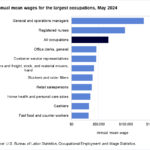 Bls minimum wage by state
States with the Highest Minimum Wages in 2025
In 2025, several states lead the nation in setting ambitious minimum wage standards to better reflect the actual cost of living. States like California, Washington, Massachusetts, and Connecticut have minimum wages at or above $15 per hour, with some jurisdictions within these states going even higher.
For instance, California has set its statewide minimum at $16.00 per hour, while cities such as San Francisco and Los Angeles have surpassed that, with rates reaching up to $18.07 and $17.64 respectively. Washington state follows closely with a minimum wage of $16.28 per hour, adjusted annually for inflation.
These leadership roles reflect a broader trend in high-cost-of-living states where lawmakers recognize that the federal benchmark is no longer sufficient to sustain basic needs. Such policies are often supported by strong labor unions, progressive political leadership, and public initiatives aimed at reducing income inequality and improving worker retention and productivity.
States That Adhere to the Federal Minimum Wage in 2025
Despite increasing wage floors in many regions, a notable number of states continue to follow the federal minimum wage of $7.25 per hour without establishing a higher state-level standard. These states are primarily concentrated in the South and Midwest, including Alabama, Mississippi, Louisiana, Tennessee, and South Carolina, among others.
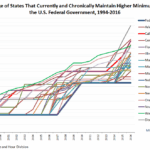 Chart of minimum wage by state
In these states, employers covered by the Fair Labor Standards Act (FLSA) must pay only the federal rate, unless local ordinances impose higher wages—though such local laws are often prohibited by state preemption laws. Advocates argue that stagnant wages in these regions contribute to higher poverty rates and reduced consumer spending power, while opponents claim that higher wages could lead to job losses or increased automation.
The absence of state-level increases highlights the political and economic challenges of raising wages in areas where small businesses and agricultural sectors dominate. Consequently, many workers in these states rely on multiple jobs or government assistance to meet their basic needs, underscoring the ongoing national debate over wage equity.
Projected Minimum Wage Changes and Indexing Policies by 2025
As of 2025, many states have implemented or expanded indexing policies that automatically adjust the minimum wage annually based on inflation or the Consumer Price Index (CPI).
This mechanism prevents the real value of the minimum wage from eroding over time and reduces the need for frequent legislative battles. States like Florida, Arizona, Colorado, and Oregon use automatic adjustments to ensure their minimum wages keep pace with rising living costs.
For example, Florida voters approved a gradual increase to $15 per hour by 2026, with incremental adjustments each year that continue to rise with inflation. Similarly, Oregon adjusts rates annually in regional tiers—$15.45 in the Portland metro area, $14.20 in standard counties, and $12.95 in non-urban counties—accounting for geographic economic differences.
These indexing systems provide predictability for both employers and employees and are becoming a model for sustainable wage policy. As economic uncertainty persists, more states may adopt similar mechanisms to maintain wage stability and address long-term affordability challenges.
| State | 2025 Minimum Wage ($/hr) | Tipped Wage ($/hr) | Notes |
|---|---|---|---|
| California | 16.00 | 16.00 | Statewide rate; some cities have higher local rates. |
| Washington | 16.28 | 16.28 | Adjusted annually for inflation. |
| New York | 15.00 – 16.00 | 10.95 – 12.50 | Varies by region and county size. |
| Florida | 13.00 | 8.98 | Will reach $15.00 by 2026; adjusted yearly. |
| Texas | 7.25 | 2.13 | Follows federal minimum; no state minimum above it. |
| Maine | 14.15 | 6.38 | Indexing to inflation; tipped wage rises with base. |
| Mississippi | 7.25 | 2.13 | No state minimum wage law; defaults to federal. |
Frequently Asked Questions
What is the minimum wage by state in the US for 2025?
As of 2025, the minimum wage varies by state, with no single federal rate applying nationwide. While the federal minimum remains $7.25, many states have set higher rates. For example, California and Washington have among the highest, exceeding $16 per hour. States like Florida and Illinois continue scheduled increases. Employers must follow the higher of federal, state, or local minimum wages where applicable.
Which states will have the highest minimum wage in 2025?
In 2025, California, Washington, and Massachusetts are expected to have some of the highest minimum wages, all above $15 per hour, with certain cities even higher. Washington state may exceed $16.50 in some areas. These rates result from automatic inflation adjustments and legislative increases. Employers in these states must comply with updated rates, and workers should verify local ordinances that could set even higher wage floors.
Are there states not increasing minimum wage in 2025?
Yes, some states are not scheduled to increase their minimum wage in 2025. States like Mississippi, Alabama, and Tennessee lack state-level minimum wage laws, defaulting to the federal rate of $7.25. Others, such as Wyoming and Georgia, set rates below $7.25, but federal law still requires at least $7.25. In these states, proposed increases may be under discussion, but no automatic adjustments are planned for 2025.
How are minimum wage increases determined by state?
Minimum wage increases are determined by state legislation or ballot initiatives. Some states have laws linking wages to inflation, resulting in annual adjustments. Others pass new laws to raise the rate incrementally. Local governments may also set higher rates. Factors influencing decisions include cost of living, economic conditions, and political priorities. Workers and employers should monitor official state labor department announcements for accurate updates.
Leave a Reply