
Minimum wage by states 2025
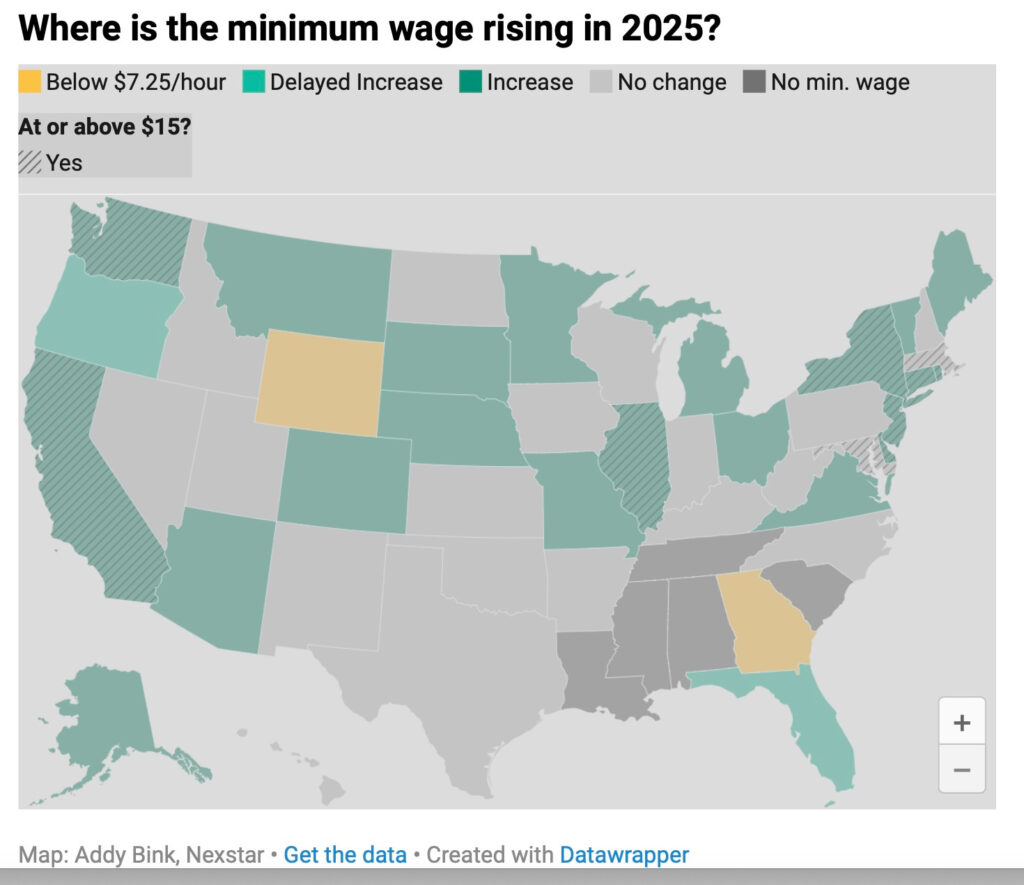
As 2025 approaches, the landscape of minimum wage laws across the United States continues to evolve, reflecting regional economic conditions and policy priorities.
With growing pressure to address rising living costs, numerous states are reassessing their minimum wage standards, resulting in a patchwork of differing rates. While the federal minimum wage remains unchanged, many states and localities have implemented higher thresholds to support workers.
This article examines the projected minimum wage rates by state in 2025, highlighting increases, regional disparities, and the implications for employees and businesses. Understanding these variations is crucial for policymakers, employers, and workers navigating the changing economic environment.
 New jersey sue employer and file workers compensation simultaneously
Minimum Wage by States in 2025: What Workers and Employers Need to Know
As the cost of living continues to rise across the United States, the debate over minimum wage policies intensifies, with states taking divergent paths in setting wage floors for workers. By 2025, the federal minimum wage will remain at $7.25 per hour, unchanged since 2009, while a growing number of states will implement their own higher wage standards.
These state-level adjustments are driven by local economic conditions, inflation rates, legislative initiatives, and advocacy from labor groups. Some states have already enacted automatic cost-of-living adjustments (COLAs), which index the minimum wage to inflation, ensuring wages rise with economic shifts.
The result is a complex and fragmented landscape where workers in one state could earn significantly more than those in a neighboring state for the same work. Understanding these differences is critical for employees, employers, and policymakers navigating economic fairness, business sustainability, and regional competitiveness.
States with the Highest Minimum Wages in 2025
By 2025, several states will lead the nation in setting some of the highest minimum wage rates, reflecting both strong labor advocacy and high living costs.
 New jersey workers compensation independent contractors eligibility
Washington and California are projected to have among the highest rates, with Washington reaching approximately $16.75 per hour and California close behind at $16.50 per hour, not including local city-level ordinances. The District of Columbia, while not a state, will maintain one of the highest rates in the country at $17.00 per hour.
Other states like Massachusetts, New York, and Connecticut will also set their minimum wages above $15, with New York implementing regional wage tiers based on geography and business size to account for economic disparities within the state. These elevated wage floors aim to support low-income workers in high-cost urban centers, though some businesses argue such increases could lead to reduced hiring or higher consumer prices.
| State | 2025 Minimum Wage ($/hour) | Notes |
|---|---|---|
| Washington | 16.75 | Includes annual COLA adjustments |
| California | 16.50 | Some cities like San Francisco may exceed $18 |
| District of Columbia | 17.00 | One of the highest in the nation |
| Massachusetts | 15.75 | Increases tied to inflation after 2023 |
| New York | 16.00 (varies by region) | NYC: $16.00, Upstate: $15.00 |
States That Maintain the Federal Minimum Wage in 2025
Despite national pressure to raise wages, a significant number of states will still adhere to the federal minimum wage of $7.25 per hour in 2025, particularly in regions with historically lower labor costs and conservative economic policies.
States such as Mississippi, Alabama, Louisiana, Tennessee, and Idaho do not have state-level minimum wage laws or have laws that default to the federal rate when no higher standard is set. In these states, employers are only legally required to pay $7.25, unless they qualify for certain exemptions or participate in training programs with lower wage allowances.
 New jersey workers compensation settlement duration
Advocacy groups continue to push for reform, highlighting that $7.25 is below the poverty line for full-time workers, yet legislative gridlock and concerns about small business impacts slow progress. Workers in these states often rely on tips, secondary jobs, or public assistance to meet basic needs, underscoring a growing economic divide between regions.
States with Planned Minimum Wage Increases by 2025
Several states have legislated gradual minimum wage increases set to culminate or continue into 2025, signaling a long-term shift toward higher pay standards. For example, Illinois is implementing a phased plan to reach $15 per hour by 2025, with annual increases starting in 2020.
Similarly, Florida, after a voter-approved initiative in 2020, will increase its rate to $15 per hour by September 2025, having already reached $13 in 2023. Ohio and Michigan are also seeing incremental hikes, with both states indexing future increases to inflation after reaching base rates of $10.65 and $10.34 respectively, moving toward $15 by 2027–2028.
These efforts reflect a broader trend of ballot-driven wage reforms, where voters directly influence labor policy. The scheduled rises are expected to impact millions of low-wage workers in retail, hospitality, and food service industries, though some business associations warn of potential automation and employment reductions.
Frequently Asked Questions
What will be the minimum wage in California in 2025?
In 2025, California's minimum wage is expected to rise to $16.50 per hour statewide. Some cities, like Los Angeles and San Francisco, may set higher rates based on local cost-of-living adjustments. Employers must comply with the higher of state or local minimum wages. The exact figures will be confirmed closer to 2025 based on inflation and legislative updates.
Which states will have a $15 minimum wage by 2025?
By 2025, states expected to reach or exceed a $15 minimum wage include California, Washington, Massachusetts, Connecticut, and New York.
Some cities in other states may also hit $15 through local ordinances. Several states like Illinois and Maryland are scheduled to reach $15 in 2025 or shortly after, depending on economic indicators and phased-in plans.
Will federal minimum wage increase in 2025?
The federal minimum wage is set at $7.25 per hour and is unlikely to increase in 2025 without congressional action. No major legislation has been passed to raise it recently. Most wage increases will continue to occur at the state or city level. Workers are entitled to the higher of federal, state, or local minimum wage rates.
How do state minimum wages differ in 2025?
In 2025, state minimum wages will vary widely, from the federal minimum of $7.25 to over $16 in states like California and Washington. Differences are driven by cost of living, local economies, and state legislation. Some states adjust annually for inflation, while others have fixed schedules. Employers must follow the highest applicable wage standard—federal, state, or local.
Leave a Reply