
Minimum wage by state 2021
In 2021, the minimum wage varied significantly across the United States, reflecting a complex patchwork of state and local laws.
While the federal minimum wage remained at $7.25 per hour, many states implemented higher rates to address rising living costs. Some states, like California and Washington, had minimum wages well above the national floor, while others adhered to the federal standard or set rates in between.
Several states also introduced plans to gradually increase wages in the coming years. These disparities highlight ongoing debates about economic equity, labor rights, and regional economic conditions, making the examination of minimum wage by state in 2021 a crucial lens into the broader landscape of American workers' livelihoods.
 Minimum wage by state 2026
Minimum Wage by State in 2021: A State-by-State Overview
In 2021, the minimum wage by state in the United States continued to reflect a growing disparity between federal standards and local economic needs.
While the federal minimum wage remained unchanged at $7.25 per hour, many states and cities implemented higher rates to address rising costs of living and inflation.
A total of 29 states and the District of Columbia had minimum wages exceeding the federal level as of January 1, 2021, illustrating a trend toward localized wage policies. These variations were driven by state legislation, ballot initiatives, and indexed adjustments based on inflation or cost-of-living increases.
States like Washington and California led the nation with some of the highest rates—$13.69 and $13.00 per hour, respectively—while others, including Texas and Georgia, maintained the federal floor despite economic pressures. This patchwork framework created significant differences in worker pay across state lines, particularly affecting low-wage industries such as retail, hospitality, and food services.
 Us minimum wage by state 2025
States with the Highest Minimum Wage in 2021
In 2021, several states stood out for having the highest minimum wage rates in the country, driven by legislative action and cost-of-living concerns. Washington State topped the list with a minimum wage of $13.69 per hour, thanks to annual cost-of-living adjustments mandated by state law.
Close behind was Massachusetts at $13.50, California at $13.00 (with higher rates in some cities), and Oregon, which varied by region—$13.50 in the Portland metro area, $12.00 in the standard rate zone, and $11.50 in non-urban counties.
These states demonstrated a commitment to economic equity and worker support, particularly in high-cost urban centers where $7.25 per hour would be insufficient for basic survival. The leadership of these states also influenced nearby regions to consider or implement similar wage increases.
States That Followed the Federal Minimum Wage
Despite growing momentum for higher wages, 21 states adhered to the federal minimum wage of $7.25 per hour in 2021, either because they had no separate state minimum or their state law defaulted to the federal rate. These states included Alabama, Louisiana, Mississippi, South Carolina, and Tennessee, among others.
 Map of minimum wage by state 2024
In these regions, workers in non-exempt positions were legally entitled to only the federally mandated wage, unless their employer voluntarily paid more. This created stark income disparities compared to neighboring states with higher minimums, particularly affecting low-income workers, part-time employees, and those in the service industry.
Moreover, the lack of state-level increases often reflected broader political resistance to labor reforms, despite evidence of growing income inequality and insufficient wage growth over the past decade.
Cost of Living and Minimum Wage Adjustments
One of the primary drivers behind state-level minimum wage increases in 2021 was the cost of living, which varies dramatically across the United States.
States with high housing costs, transportation expenses, and healthcare prices—such as California, New York, and Colorado—were more likely to implement indexed wage increases that adjust automatically based on inflation. This approach ensures that purchasing power does not erode over time and helps protect low-wage earners from falling into poverty.
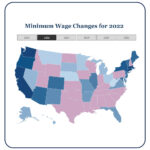 Map of minimum wage by state 2025
In contrast, states with lower living costs were less inclined to raise wages, though critics argue that even in these areas, $7.25 per hour is inadequate to meet basic needs. Cities like Seattle, San Francisco, and Washington, D.C., often surpassed even their state minimums, establishing local living wages to reflect hyper-local economic realities.
| State | Minimum Wage (2021) | Notes |
|---|---|---|
| Washington | $13.69 | Indexed to inflation; highest in the nation |
| Massachusetts | $13.50 | Gradual increases toward $15.00 by 2023 |
| California | $13.00 (small employers), $14.00 (large) | Varies by employer size; urban areas higher |
| Colorado | $12.32 | Adjusts annually based on inflation |
| New York | $12.50–$15.00 | Varies by region and county |
| Texas | $7.25 | Follows federal minimum wage |
| Georgia | $5.15 | State law sets $5.15, but federal $7.25 applies |
| Mississippi | $7.25 | No state minimum wage law |
Frequently Asked Questions
What was the federal minimum wage in 2021?
The federal minimum wage in 2021 remained $7.25 per hour, unchanged since 2009. This rate applied to covered, nonexempt employees nationwide. However, many states and localities had higher minimum wages, which took precedence where employers were subject to both federal and state laws. Employers were required to pay the higher of the two rates, meaning workers in states with elevated minimums earned more than $7.25 hourly.
Which states had the highest minimum wage in 2021?
In 2021, Washington state had the highest minimum wage at $13.69 per hour. California followed closely, with rates varying by business size, reaching $13.00 to $14.00 per hour. Massachusetts and Oregon also had high rates, around $13.50 and $12.00–$13.20 respectively, depending on the region. These figures reflected cost-of-living adjustments and state-specific legislation aimed at improving worker earnings above the federal baseline.
Did all states follow the federal minimum wage in 2021?
No, not all states followed the federal minimum wage of $7.25 per hour in 2021. Many states had their own minimum wage laws setting higher rates. In cases where state and federal laws differed, workers were entitled to the higher wage. Some states, like Georgia and Wyoming, had lower state rates but typically defaulted to the federal $7.25 for covered employers. Local ordinances in cities like Seattle and San Francisco also exceeded both state and federal levels.
How often do state minimum wages change?
State minimum wages can change annually or at multi-year intervals, depending on state laws and inflation adjustments. Some states index their minimum wage to inflation, leading to automatic yearly increases. Others require legislative approval for changes, which may occur irregularly. In 2021, over 20 states raised their minimum wage based on pre-set schedules or cost-of-living measures, while others maintained rates unchanged for several years.
Leave a Reply