
Minimum wage in 2025 by state
As 2025 approaches, the debate over the minimum wage continues to intensify across the United States, with significant variations from state to state.
Driven by rising living costs and growing pressure for economic equity, numerous states are reevaluating their wage floors to better reflect local economies. While the federal minimum wage remains stagnant at $7.25 since 2009, over half of the states have implemented higher rates, some indexing them to inflation.
This article explores the projected minimum wage levels in 2025, examining legislative changes, economic impacts, and regional disparities. Understanding these differences is essential for workers, employers, and policymakers navigating the evolving landscape of labor standards.
 minimum wage 2023 by state
Minimum Wage in 2025 by State: What to Expect Across the U.S.
As the United States moves toward 2025, the landscape of the minimum wage is undergoing significant changes across various states.
With growing pressure from both economic inflation and labor advocacy groups, many states are revising their minimum wage laws to better reflect the cost of living and ensure workers earn a more livable wage. Unlike the federal minimum wage, which has remained stagnant at $7.25 since 2009, numerous states and cities have taken independent action to raise their wage floors.
By 2025, more than half of the U.S. population will reside in states with minimum wages set above the federal level. The increases vary widely depending on location, legislative priorities, and economic conditions, creating a patchwork system that reflects regional differences in the labor market and inflation rates.
Current State of Minimum Wage Laws in 2025
In 2025, minimum wage laws differ drastically from state to state, with some states aligning with the outdated federal rate while others have instituted substantial increases.
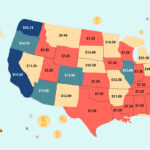 Minimum wage 2025 by state chart
States like California and Washington lead the nation with their minimum wage exceeding $16 per hour, driven by legislation tied to annual cost-of-living adjustments.
On the other hand, states such as Georgia and Wyoming officially maintain a minimum wage below the federal standard, though federal law supersedes in practice, ensuring workers receive at least $7.25. Several states—including Illinois, New York, and Maryland—have phased in increases over recent years, aiming to reach $15 per hour by 2025.
Moreover, numerous cities and counties, including Seattle, Denver, and San Francisco, enforce even higher local minimum wages, emphasizing the growing trend of local-level wage activism.
Projected Minimum Wage Increases by Region
Regional patterns in minimum wage policy are evident as of 2025, with the Northeast and West Coast states generally implementing the most aggressive wage hikes.
 General liability vs workers compensation
For example, Massachusetts and Connecticut have scheduled increases that will place their rates above $15, while Oregon differentiates wages by region—urban areas like Portland have higher rates than rural counties. In the Midwest, states such as Michigan and Minnesota have passed legislation to gradually reach $15, often with specific timelines tied to inflation.
Meanwhile, the Southern U.S. remains largely resistant to increases, with states like Texas, Alabama, and Mississippi adhering strictly to the federal rate and showing little legislative intent to raise it. This regional disparity underscores the political and economic divide in wage policy across the U.S., impacting worker mobility and business operations.
Comparison Table: Minimum Wage by Selected States in 2025
| State | Minimum Wage (2025) | Federal vs. State Rate | Notes |
|---|---|---|---|
| California | $16.00 | State higher | Annual adjustments based on inflation; some cities higher. |
| New York | $15.00 – $16.00 (varies by region) | State higher | Rate depends on size of employer and location (e.g., NYC vs. upstate). |
| Texas | $7.25 | Federal applies | No state minimum wage law; federal rate enforced. |
| Washington | $16.28 | State higher | Highest state minimum wage; adjusted annually for inflation. |
| Florida | $12.00 | State higher | On path to $15 by 2026 via voter-approved initiative. |
| Illinois | $15.00 | State higher | Phase-in completed in 2025 for most workers. |
Frequently Asked Questions
What is the projected minimum wage in California for 2025?
California is expected to raise its minimum wage to $16.50 per hour in 2025 for all employers, following its annual inflation-based adjustment.
Some cities like Los Angeles and San Francisco may set higher local rates. Employers must comply with the highest applicable rate, whether state, local, or industry-specific. These increases aim to support living costs in high-expense areas across the state.
Will Texas increase its minimum wage in 2025?
No, Texas is not expected to raise its minimum wage in 2025. The state follows the federal minimum wage of $7.25 per hour, as it does not have a state-mandated higher rate.
Wage increases in Texas depend on federal action or local ordinances, but most cities cannot set their own minimum wages due to state law. Workers in certain sectors may earn more through company policies or union agreements.
Which states plan the highest minimum wage by 2025?
By 2025, Washington and Massachusetts are projected to have some of the highest state minimum wages, reaching $16.75 and $16.00 per hour, respectively.
Washington, D.C. will lead at $17.00, though it is a district. Other high-wage states include California and New York, both exceeding $16.00. These increases reflect cost-of-living adjustments and legislative efforts to ensure livable incomes for workers.
How are minimum wage increases determined by state?
States determine minimum wage increases through legislation, ballot measures, or automatic cost-of-living adjustments. Some states tie wages to inflation, updating them yearly.
Others set fixed timelines for increases, while a few rely on federal standards. Local governments may impose higher rates where permitted. Factors influencing changes include economic conditions, housing costs, and advocacy from labor groups and policymakers.
Leave a Reply