
Minimum tipped wage by state
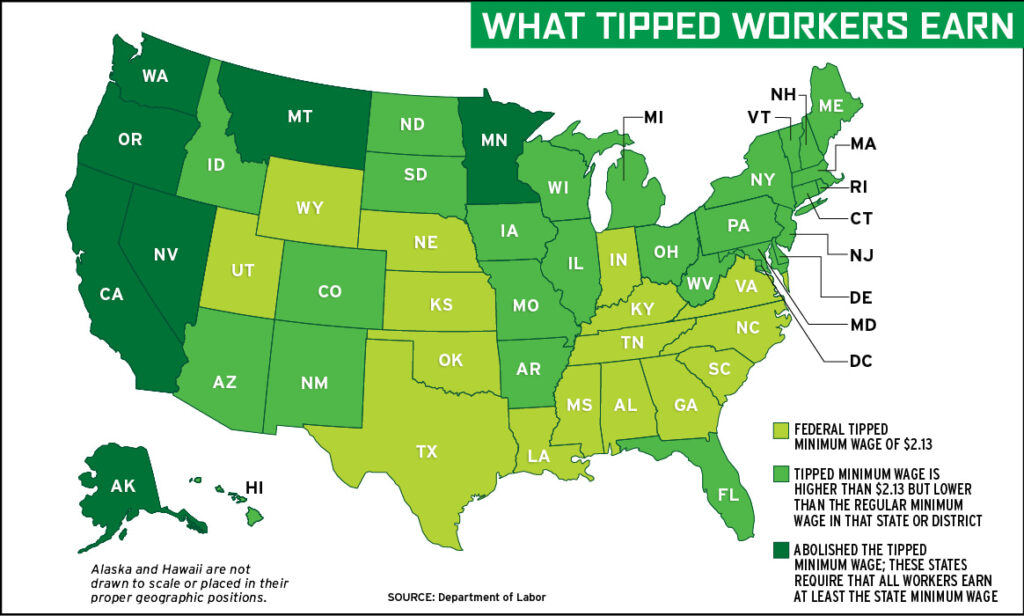
The minimum tipped wage varies significantly across the United States, reflecting a complex patchwork of state and federal labor policies.
While the federal government sets a baseline tipped minimum wage, many states establish their own rates, some higher than the federal standard and others adhering strictly to it. This variation impacts millions of service industry workers, including servers, bartenders, and delivery drivers, who rely on tips to supplement their income.
Understanding these differences is crucial for both employees and employers navigating wage compliance. This article explores the current minimum tipped wage in each state, highlights key discrepancies, and examines the ongoing debate over fair compensation for tipped workers.
 Process for workers compensation
Understanding the Minimum Tipped Wage by State in the United States
The minimum tipped wage varies significantly across U.S. states, reflecting a complex landscape of labor laws designed to balance fair compensation for service workers with the economic realities of the hospitality industry.
A tipped employee is typically someone who regularly earns more than $30 per month in tips, and federal law allows employers to pay a lower direct wage—known as a tip credit—as long as tips bring the employee’s total earnings up to at least the standard minimum wage. Under the Fair Labor Standards Act (FLSA), the federal minimum cash wage for tipped workers is $2.13 per hour, a rate unchanged since 1991.
However, many states have enacted higher tipped minimum wages, and some have eliminated the tip credit system entirely, requiring employers to pay the full state minimum wage before tips. This patchwork system creates notable disparities for workers depending on their location, with states like California, Washington, and Minnesota leading the way in ensuring tipped workers receive the same base pay as non-tipped employees.
Conversely, states such as Texas, Florida, and Georgia adhere closely to the federal minimum tipped wage, placing greater financial reliance on customer gratuities. As public debate intensifies over fair wages and income stability in the service sector, understanding these state-by-state differences is crucial for workers, employers, and policymakers alike.
 Affordable hvac workers compensation insurance providers
How Tip Credits Work in Different States
The concept of a tip credit allows employers to count a portion of an employee’s tips toward meeting minimum wage obligations, but its application varies widely.
In states that follow federal guidelines, employers may pay as little as $2.13 per hour in direct wages, provided tips make up the difference to reach the regular minimum wage. For example, in North Carolina, employers can take a maximum tip credit of $5.12, meaning the minimum cash wage is $2.13 (since the state minimum wage is $7.25).
However, in states with higher base wages, such as New York ($15.00+ depending on region), the allowable tip credit is capped, and employers must pay a higher direct cash wage—ranging from $10.00 to $12.55 depending on the area.
Some states, including Alaska, California, Montana, Minnesota, Nevada, Oregon, and Washington, do not permit tip credits at all, requiring employers to pay the full state minimum wage before tips are considered.
 Best law firms chicago workers' compensation claims
This ensures greater income stability for workers but also increases labor costs for businesses. Understanding how tip credits are calculated and regulated in each state is essential for ensuring compliance and protecting worker rights.
States with the Highest and Lowest Tipped Wages
There is a significant gap between states offering the most and least financial security for tipped workers. At the higher end, Washington state mandates a base wage equal to its general minimum wage—$16.28 per hour in 2024—making it one of the most favorable states for tipped employees. California, Oregon, and Alaska follow similar models, eliminating the subminimum wage entirely.
In contrast, seven states—Alabama, Georgia, Idaho, Indiana, Kansas, Mississippi, and South Carolina—have no state-specific minimum wage law for tipped employees, defaulting to the federal rate of $2.13 per hour. This means that in these states, workers' livelihoods depend heavily on customer generosity, which can lead to income volatility and economic vulnerability.
Additionally, in states like Texas and Florida, while there is a state minimum wage, it still allows employers to pay $2.13 per hour in direct wages as long as tips cover the gap to the full minimum. Advocates for wage reform argue that such disparities perpetuate inequity in the service industry, particularly affecting women and people of color who are overrepresented in tipped occupations.
Recent Legislative Trends and Worker Advocacy
In recent years, advocacy for a fairer tipped wage system has led to significant legislative changes across multiple states. Movements like the “One Fair Wage” campaign have pushed for the elimination of the subminimum tipped wage, citing research that shows tipped workers experience higher rates of poverty and harassment when their income depends on tips.
As a result, states such as Colorado, Maine, Nevada, and Hawaii have implemented gradual phase-outs of the tip credit, with full implementation dates set in the coming years.
In 2023, Maryland passed a law to raise its tipped wage incrementally until it reaches 70% of the state minimum wage by 2026. Similarly, Illinois has committed to closing the gap, planning to raise the tipped minimum wage to match the regular minimum wage by 2027.
These reforms reflect a growing recognition of the need for stable, predictable incomes for all workers, regardless of occupation. Additionally, cities like Seattle and San Francisco have adopted local laws that exceed state requirements, further highlighting a shift toward equitable pay structures within the service sector.
| State | Minimum Tipped Wage (2024) | Tips Count Toward Minimum Wage? | Notes |
|---|---|---|---|
| California | $16.00 | No | No tip credit allowed; employer must pay full minimum wage. |
| Washington | $16.28 | No | Same as regular minimum wage; high pay protects worker stability. |
| New York | $12.55–$14.00 | Yes | Varies by region; tip credit allowed up to certain limit. |
| Texas | $2.13 | Yes | Follows federal tipped minimum; full minimum is $7.25. |
| Florida | $7.98 | Yes | Tipped wage set at $4.98 below standard minimum wage ($12.00). |
| Maine | $6.79 |
Frequently Asked Questions
What is the minimum tipped wage by state in the U.S.?
The minimum tipped wage varies by state, as federal law allows employers to pay tipped employees as low as $2.13 per hour as long as tips bring their earnings up to the federal minimum wage of $7.25. However, many states set higher tipped minimums or require employers to pay the full state minimum wage before tips. States like California and Washington do not allow a tipped credit, ensuring all workers earn at least the full minimum wage.
Which states have the highest tipped minimum wage?
States such as California, Washington, and Oregon have some of the highest tipped minimum wages because they do not allow a tip credit. This means tipped employees must be paid the full state minimum wage, ranging from $14.00 to over $16.00 per hour in 2024.
Unlike states that permit lower base wages for tipped workers, these states ensure consistent pay regardless of tips, providing greater income stability for service industry employees in high-cost areas.
Can employers pay less than minimum wage to tipped employees?
Under federal law, employers can pay tipped employees a minimum cash wage of $2.13 per hour if tips bring their total earnings to at least the federal minimum wage of $7.25.
However, if tips combined with wages do not meet the required minimum, the employer must make up the difference.
Many states have laws requiring higher base wages, and some do not allow subminimum tipped wages at all, ensuring fairer compensation.
How do tipped wage laws differ between states?
Tipped wage laws vary significantly across the country. While the federal tipped minimum wage is $2.13 per hour, more than half of U.S. states have set higher rates.
Some states—such as Alaska and Nevada—require employers to pay close to or the full state minimum wage before tips.
Others—like Texas and Florida—follow the federal model but with higher base rates.
In all cases, employers must follow the law that provides the highest minimum compensation within each state.
Leave a Reply