
Amendment against racial discrimination

Racial discrimination has long been a pervasive issue affecting societies worldwide, undermining equality and justice.
In response, amendments targeting racial discrimination have emerged as critical legal tools to protect marginalized communities and promote inclusivity. Such amendments aim to eliminate systemic biases in areas like employment, education, housing, and law enforcement.
By reinforcing anti-discrimination laws, they seek to hold institutions accountable and ensure fair treatment for all individuals, regardless of race or ethnicity. These legislative efforts reflect a growing commitment to human rights and social equity. However, their effectiveness depends on enforcement, public awareness, and sustained political will.
 Amendment racial discrimination
Strengthening Constitutional Protections Through an Amendment Against Racial Discrimination
An amendment against racial discrimination would serve as a powerful legal and moral statement in the ongoing effort to achieve equality and justice under the law.
While the United States Constitution and civil rights legislation have historically provided tools to combat racial injustice—such as the Equal Protection Clause of the Fourteenth Amendment and the Civil Rights Act of 1964—systemic racism and discriminatory practices persist in areas like criminal justice, education, voting rights, and housing.
A dedicated constitutional amendment explicitly prohibiting racial discrimination would close existing legal gaps, provide a stronger foundation for judicial enforcement, and affirm an unambiguous national commitment to racial equity.
Such an amendment could empower Congress to pass more effective anti-discrimination laws, offer individuals greater recourse when their rights are violated, and signal to future generations that racial injustice will not be tolerated in American law or society.
 Wrongful termination lawyer beverly hills
The Historical Need for a Constitutional Amendment on Racial Discrimination
Despite landmark advances during the Civil Rights Movement, constitutional provisions have often been interpreted narrowly when challenging racial discrimination.
The Fourteenth Amendment guarantees equal protection, but court rulings have frequently required proof of intentional discrimination, making it difficult to address systemic and institutionalized racism. A new amendment specifically targeting racial discrimination would eliminate interpretive ambiguities and reinforce the principle that racial equality is a fundamental right.
It would build on earlier efforts such as the proposed Equal Rights Amendment and respond to modern civil rights movements that highlight the continued presence of racial disparities in policing, education, and economic opportunity, thus affirming the need for a permanent, unassailable constitutional safeguard.
The adoption of an amendment against racial discrimination would have far-reaching legal and social consequences.
 Wrongful termination attorneys beverly hills
Legally, it would empower Congress to pass more comprehensive anti-discrimination legislation and strengthen the judiciary’s ability to strike down racially biased policies. Courts could apply a higher standard of scrutiny to laws and practices that result in disproportionate racial harm, even in the absence of explicit discriminatory intent.
Socially, such an amendment would validate the lived experiences of marginalized communities, foster greater public trust in institutions, and encourage national dialogue around race and equity. It could also inspire reforms in areas such as school funding, redistricting, employment practices, and law enforcement, ultimately promoting a more inclusive and just society.
Comparative Global Perspectives on Constitutional Anti-Discrimination Measures
Many democracies around the world have incorporated explicit anti-discrimination clauses into their constitutions, offering valuable models for the United States.
Countries like South Africa, India, and Germany include strong constitutional prohibitions on racial and ethnic discrimination, often coupled with affirmative action provisions and independent human rights commissions. South Africa’s post-apartheid constitution, for instance, not only bans racial discrimination but also mandates legislative and executive action to promote equality.
 Wrongful termination law firm beverly hills
These international examples demonstrate that constitutional language alone is not sufficient—effective enforcement mechanisms and political will are essential. By examining these global frameworks, the U.S. can design a robust amendment that not only prohibits racial discrimination but also promotes active measures to dismantle structural inequities.
| Aspect | Current U.S. Framework | Potential Amendment Impact |
|---|---|---|
| Legal Standard | Equal Protection Clause requires proof of intentional discrimination | Would allow challenges based on disparate impact and systemic bias |
| Congressional Authority | Limited enforcement powers under existing amendments | Enhanced authority to pass comprehensive anti-discrimination laws |
| Individual Recourse | Varies by jurisdiction; often difficult to prove claims | Stronger legal standing for individuals facing racial inequities |
| International Alignment | Lags behind constitutions in South Africa, Germany, and Canada | Brings U.S. in line with global human rights standards |
| Societal Message | Equality is implied but not explicitly enshrined against race | Sends a clear, unambiguous message of national commitment to racial justice |
Comprehensive Guide to the Amendment Against Racial Discrimination
What were the 42nd and 44th Amendments in relation to anti-discrimination measures?
Key Changes Introduced by the 42nd Amendment Regarding Anti-Discrimination
- The 42nd Amendment to the Constitution of India, enacted in 1976 during the Emergency period, reinforced the state's commitment to reducing inequalities and promoting social justice, which indirectly supported anti-discrimination objectives. It emphasized the directive principles of state policy, including the promotion of equal opportunity and the reduction of income disparities among individuals and groups.
- This amendment added the words social, economic and political justice to the Preamble, reaffirming the foundational principles that aim to eliminate discrimination based on class, caste, or economic status. By embedding justice more prominently, it strengthened the constitutional basis for future anti-discrimination legislation and judicial interpretation.
- While the 42nd Amendment did not introduce specific anti-discrimination provisions, it expanded the role of fundamental duties, requiring citizens to promote harmony and the spirit of common brotherhood across all sections of society, transcending divisions of religion, language, region, or caste—thereby contributing to a broad anti-discriminatory ethos.
Impact of the 44th Amendment on Civil Liberties and Equality
- The 44th Amendment, passed in 1978 after the Emergency, aimed to restore civil liberties and balance powers between the executive and judiciary, which had been eroded under the 42nd Amendment. This shift was critical for protecting marginalized groups from state-sponsored discrimination during periods of political crisis.
- It removed the unfettered power of the government to suspend fundamental rights, including the right to life and personal liberty, during emergencies. This safeguard ensured that anti-discrimination protections under Articles 14 (equality before law), 15 (prohibition of discrimination), and 21 (protection of life and liberty) could not be arbitrarily suspended, reinforcing constitutional defenses against systemic discrimination.
- By limiting the scope of emergency provisions and restoring judicial review, the 44th Amendment fortified legal mechanisms through which individuals could challenge discriminatory laws or actions, ensuring greater accountability and equity in governance.
Constitutional Evolution of Anti-Discrimination Frameworks
- The interplay between the 42nd and 44th Amendments illustrates the evolving nature of India’s anti-discrimination framework—where the 42nd sought to strengthen socio-economic equity through directive principles, and the 44th worked to protect civil rights from executive overreach, both contributing to a more robust equality regime.
- Together, these amendments reflect a constitutional dialogue on balancing state authority with individual rights. The 42nd's emphasis on social justice complemented the 44th's role in reasserting the inviolability of fundamental rights, especially for vulnerable communities often targeted by discriminatory practices.
- The cumulative effect of these amendments laid a foundation for later judicial activism and legislative measures targeting caste, gender, religious, and economic discrimination, demonstrating how constitutional amendments can shape both the principles and practical enforcement of equality in a diverse democracy.
What is the text of the 15th Amendment concerning racial discrimination?
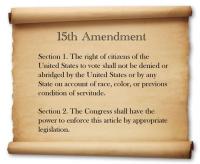
Text of the 15th Amendment
- The 15th Amendment to the United States Constitution states: The right of citizens of the United States to vote shall not be denied or abridged by the United States or by any State on account of race, color, or previous condition of servitude. This clause explicitly prohibits any government entity in the U.S. from preventing individuals from voting based solely on their race, skin color, or history of enslavement.
- The second section of the amendment grants Congress the authority to enforce this article through appropriate legislation. This enforcement power has been used throughout history to pass laws aimed at protecting voting rights, including the Voting Rights Act of 1965.
- The amendment was ratified on February 3, 1870, during the Reconstruction Era, and marked a significant milestone in constitutional efforts to secure civil rights for African American men following the Civil War.
Historical Context of the 15th Amendment
- The 15th Amendment emerged in the aftermath of the Civil War, when the federal government sought to integrate formerly enslaved people into American civic life. With the abolition of slavery via the 13th Amendment and citizenship established under the 14th Amendment, securing the right to vote became a central goal.
- During the Reconstruction period, African American men exercised their voting rights in the Southern states, electing numerous Black officials to local, state, and federal offices. However, this progress was met with strong resistance from white supremacist groups and Southern state governments.
- Despite the constitutional guarantee, many states implemented discriminatory practices such as literacy tests, poll taxes, and grandfather clauses to disenfranchise Black voters. These tactics effectively undermined the 15th Amendment’s intent for decades, particularly in the South.
Impact and Enforcement of the 15th Amendment
- The practical impact of the 15th Amendment was limited for nearly a century due to widespread voter suppression tactics and Supreme Court rulings that weakened federal enforcement. For example, in the 1875 case United States v. Cruikshank, the Court restricted federal power to prosecute individuals who interfered with voting rights.
- It wasn't until the mid-20th century that the amendment began to be meaningfully enforced. The Civil Rights Movement played a crucial role in exposing voting discrimination, leading to federal intervention and new legislation.
- The Voting Rights Act of 1965 was a landmark piece of legislation that empowered the federal government to oversee elections in areas with a history of discrimination, enforce the provisions of the 15th Amendment, and prohibit discriminatory voting practices. This act significantly expanded access to the ballot for African Americans and other marginalized groups.
Frequently Asked Questions
What is an amendment against racial discrimination?
An amendment against racial discrimination is a legal provision added to a constitution or law to prohibit discrimination based on race, ethnicity, or national origin. It ensures equal protection under the law for all individuals, promotes social justice, and strengthens anti-discrimination policies. Such amendments often empower governments and courts to enforce civil rights and provide remedies for victims of racial bias.
Why is a constitutional amendment needed to address racial discrimination?
A constitutional amendment is necessary because it establishes a permanent, enforceable legal foundation for equality. Unlike regular laws, constitutional amendments are harder to overturn and apply universally across all levels of government. This ensures that racial equality is protected as a fundamental right, reinforcing accountability and helping dismantle systemic racism in institutions like education, employment, and criminal justice.
 Wrongful termination lawyer huntington beach
How does an amendment against racial discrimination impact existing laws?
An amendment against racial discrimination requires all existing laws to be interpreted and applied in a way that upholds equality. It can render discriminatory laws unconstitutional and lead to their repeal or revision. Courts may use the amendment to strike down policies or practices that perpetuate racial bias, ensuring that legislation in areas like housing, voting, and policing aligns with principles of fairness and non-discrimination.
Can an amendment eliminate racial discrimination completely?
While an amendment cannot instantly eliminate racial discrimination, it provides a critical legal framework to combat it. It enables enforcement of anti-discrimination laws, supports education and policy reforms, and legitimizes efforts to promote equity. Lasting change also requires societal commitment, inclusive policies, and ongoing advocacy. The amendment serves as a foundational tool in the long-term fight for racial justice and equality.
Leave a Reply