
Osha forklift safety standards
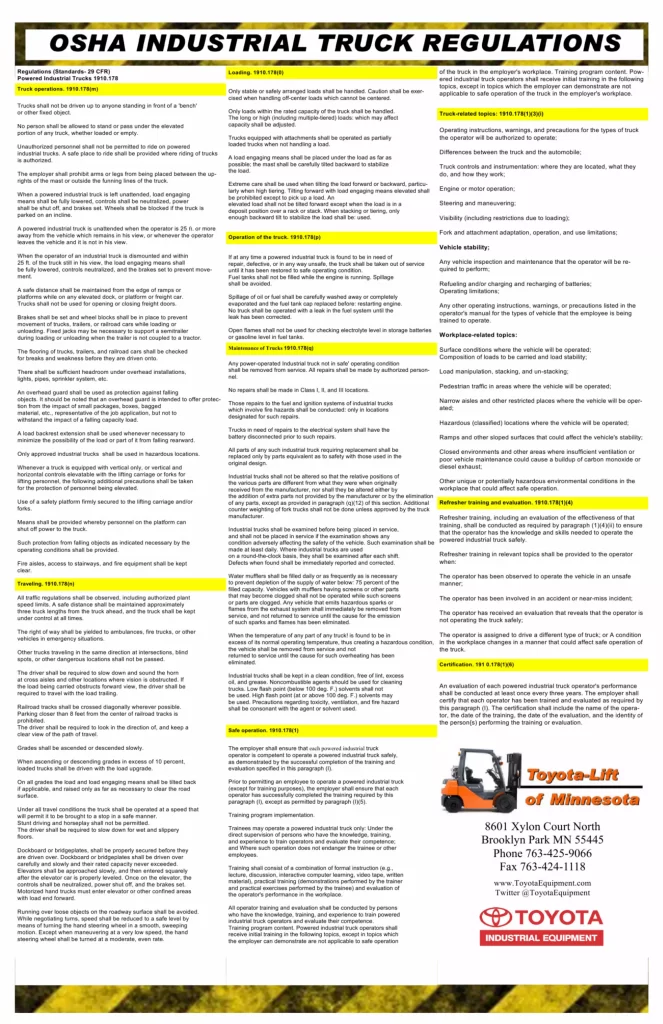
Every year, forklift accidents result in numerous workplace injuries and fatalities, making safety a critical concern in industrial environments. The Occupational Safety and Health Administration (OSHA) has established comprehensive forklift safety standards to reduce hazards and protect employees. These regulations cover operator training, certification, equipment maintenance, and safe operating procedures.
Employers must ensure that all forklift operators are properly trained and evaluated, while also conducting regular inspections and adhering to safe loading practices. Compliance with OSHA forklift safety standards not only helps prevent accidents but also promotes a culture of safety in warehouses, construction sites, and manufacturing facilities across the United States.
Understanding OSHA Forklift Safety Standards
The Occupational Safety and Health Administration (OSHA) establishes strict guidelines to ensure the safe operation of forklifts in the workplace under 29 CFR 1910.178.
 Workers compensation claim adjudication fees
These standards are designed to reduce the number of injuries, fatalities, and property damage associated with forklift use. Employers are required to implement comprehensive forklift safety programs, including operator training, vehicle inspections, and adherence to operational rules such as speed limits and proper load handling.
OSHA mandates that all forklift operators be qualified through certified training and evaluation, ensuring they understand the equipment’s capabilities and limitations. Compliance with these standards not only enhances workplace safety but also helps businesses avoid fines and legal liabilities.
Operator Training and Certification Requirements
OSHA requires that all forklift operators receive formal instruction, practical training, and a performance evaluation before operating a forklift in the workplace. Training must cover topics such as vehicle inspection procedures, stability principles, load handling, and workplace-specific hazards. Operators must be certified by their employer after successfully demonstrating competency, and recertification is required every three years or after an incident, change in equipment, or unsafe operation behavior. Only authorized personnel who have completed this process should be allowed to operate industrial trucks, and employers must maintain training records for the duration of the operator’s employment plus an additional three years.
Pre-Operation Inspection Procedures
Before each shift, forklift operators must conduct a thorough pre-operational inspection to ensure the equipment is in safe working condition. This includes checking for leaks, tire damage, fluid levels, control responsiveness, horn functionality, and visible structural defects. If any defect is found that could compromise safety, the forklift must be taken out of service immediately and labeled as defective. OSHA emphasizes that daily inspection reports should be documented and retained. Ignoring pre-use checks increases the risk of mechanical failure, accidents, and non-compliance with federal regulations.
 Workers compensation disability attorney
Safe Operating Practices and Workplace Design
OSHA outlines several safe operating practices that must be followed to minimize forklift-related incidents. These include maintaining a safe speed, using seatbelts when available, ensuring clear visibility at all times, and avoiding ramps or inclines when heavily loaded. Employers must also design workplace traffic patterns that separate forklifts from pedestrian traffic using signage, markings, and physical barriers. Adequate lighting, floor conditions, and aisle width must be maintained to accommodate safe forklift maneuvering. Prohibitions on elevating personnel on forks unless equipped with approved platforms are strictly enforced to prevent falls and electrocutions.
| OSHA Requirement | Description | Frequency |
|---|---|---|
| Operator Certification | Must include classroom, hands-on training, and evaluation by a qualified trainer. Employers must certify and document. | Every 3 years or after incidents |
| Daily Inspection | Ensure brakes, steering, controls, warning devices, and tires are operational. | Before each shift |
| Speed Limits | Must follow posted limits; adjust speed for floor conditions and visibility. | At all times |
| Pedestrian Separation | Use floor markings, mirrors, alarms, and designated walkways. | Ongoing enforcement |
| Load Handling | Keep loads low, avoid overloading, and maintain center of gravity. | During all operations |
Comprehensive Guide to OSHA Forklift Safety Standards
Lack of Proper Forklift Operator Training and Certification
- One of the most frequent OSHA violations in forklift safety is the failure to ensure that operators are properly trained and certified. OSHA regulation 29 CFR 1910.178(l)(1) requires that only trained and competent individuals operate forklifts.
- Training must include both formal instruction (such as lectures or videos) and practical hands-on exercises, followed by an evaluation of the operator’s performance in the workplace.
- Employers often commit violations by allowing employees to operate forklifts without documented proof of training, failing to conduct periodic refresher training, or not re-evaluating operators after incidents or observed unsafe behavior.
Inadequate Daily Pre-Operation Inspections
- OSHA standard 29 CFR 1910.178(q)(7) mandates that forklifts be inspected before being placed into service each day, or after every shift in round-the-clock operations.
- Common violations include failing to perform visual checks, operational tests, or documentation of inspections. Operators may overlook issues such as fluid leaks, brake problems, horn malfunctions, or tire damage.
- Without consistent inspections, undetected mechanical defects can lead to equipment failure, increasing the risk of accidents, injuries, or even fatalities in the workplace.
Unsafe Operating Practices and Speed Violations
- Operating forklifts at excessive speeds, especially in congested or pedestrian-heavy areas, is a leading cause of OSHA citations under general forklift operation rules.
- Violations occur when operators fail to adjust speed for conditions such as wet floors, poor visibility, or uneven surfaces, or disregard load capacity limits, leading to tip-overs.
- Other unsafe behaviors include improper turning, driving with elevated loads, and failing to sound the horn at cross-aisles or blind spots, all of which significantly increase the risk of collisions and workplace injuries.
What is OSHA's Rule 3 for forklift safety compliance?
Understanding OSHA's Rule 3: Training and Certification Requirements
- OSHA's Rule 3 emphasizes the necessity of proper training and certification for all forklift operators in the workplace. Employers must ensure that each operator has successfully completed formal instruction, practical training, and an evaluation of performance before operating a forklift.
- The training program must cover topics such as vehicle inspection, load handling, stability principles, workplace-specific hazards, and the use of protective equipment. These components ensure that operators can safely navigate their working environment.
- Once training is complete, operators must be certified by their employer, documenting the employee’s name, the dates of training and evaluation, and the identity of the person(s) who conducted the training. This certification must be renewed if an operator is observed operating unsafely, after a workplace accident involving the operator, or when working conditions change.
Role of Employers in Forklift Operator Supervision
- Employers are responsible for supervising and re-evaluating operator performance at least once every three years, as required by OSHA standards. However, reevaluation may be necessary sooner if changes in equipment or work areas occur.
- Supervision includes ensuring that only trained and authorized personnel operate forklifts. Unauthorized use of industrial trucks is strictly prohibited under OSHA regulations to reduce the risk of accidents.
- Employers must also enforce adherence to safe operating procedures, such as maintaining slow speeds, using horns at intersections, and ensuring clear visibility when traveling. These practices are essential for minimizing workplace injuries and equipment damage.
Consequences of Non-Compliance with OSHA Rule 3
- Failure to comply with OSHA's Rule 3 regarding forklift training and certification can result in citations and significant financial penalties. Willful or repeated violations may lead to much higher fines and potential legal action.
- Non-compliance increases the likelihood of workplace accidents, which can result in serious injuries or fatalities. Forklift-related incidents are among the leading causes of occupational injuries in warehouses and manufacturing environments.
- Additionally, companies that do not follow OSHA regulations may face reputational damage, increased workers’ compensation costs, and decreased employee morale. Ensuring compliance protects both workers and the organization as a whole.
Frequently Asked Questions
What are the key OSHA forklift safety standards for operators?
OSHA requires that forklift operators be at least 18 years old and certified after completing training and evaluation. Training includes vehicle operation, workplace configurations, and hazard awareness. Refresher training is needed if an operator is observed driving unsafely, is involved in an accident, or when workplace conditions change. Certification must be renewed periodically to ensure ongoing compliance with safety standards.
Does OSHA require forklift operators to be certified?
Yes, OSHA requires all forklift operators to be certified. Certification involves classroom instruction, practical hands-on training, and an evaluation conducted by a qualified trainer. Employers must keep records of certification and ensure that only trained and authorized personnel operate forklifts. Certification must be renewed with refresher training if an operator shows deficiencies or when new equipment types are introduced.
What workplace conditions does OSHA regulate for forklift safety?
OSHA regulates workplace conditions such as floor conditions, aisles, overhead clearances, and pedestrian traffic. Employers must ensure stable, dry surfaces free of obstructions and provide adequate lighting. Aisles must be wide enough for safe travel, and overhead hazards must be clearly marked. Warning devices, signs, and barriers help protect both operators and pedestrians in shared work areas.
 Workers compensation doctor hudson county
How often should forklifts be inspected according to OSHA standards?
OSHA requires forklifts to be inspected daily before use or after each shift in round-the-clock operations. Inspections should cover brakes, steering, tires, lights, horns, and fluid levels. Any defects found must be reported and repaired before operation. Documentation of inspections is essential. These checks help maintain safe equipment performance and prevent accidents caused by mechanical failures.
Leave a Reply