
Wrongful termination lawsuits

Wrongful termination lawsuits have become an increasingly significant aspect of employment law, as workers seek accountability when they believe they have been dismissed illegally or unfairly. These legal actions arise when an employee is fired in violation of employment contracts, public policy, or anti-discrimination laws.
While employers generally operate under at-will employment in many jurisdictions, exceptions exist that protect employees from retaliatory or discriminatory dismissals. Understanding the grounds for a wrongful termination claim is essential for both employees and employers navigating workplace disputes. Such cases often hinge on documentation, company policies, and adherence to legal standards.
Understanding Wrongful Termination Lawsuits in the Workplace
Wrongful termination lawsuits arise when an employee believes they have been fired illegally, typically in violation of employment contracts, public policy, or federal, state, or local anti-discrimination laws.
 Does wrongful termination apply to at will employment
These legal actions are not based solely on unfair or harsh treatment but require a clear breach of legal or contractual employment protections. In the United States, most employment is at-will, meaning employers can terminate employees for any reason or no reason at all—unless that reason violates the law.
For a dismissal to be considered wrongful, it must involve factors such as retaliation for reporting illegal activities, discrimination based on protected characteristics, or violation of an explicit employment agreement. Employees filing these suits must provide evidence that their termination breached specific legal protections, making legal documentation and witness testimony crucial components of a successful claim.
Common Grounds for Filing a Wrongful Termination Claim
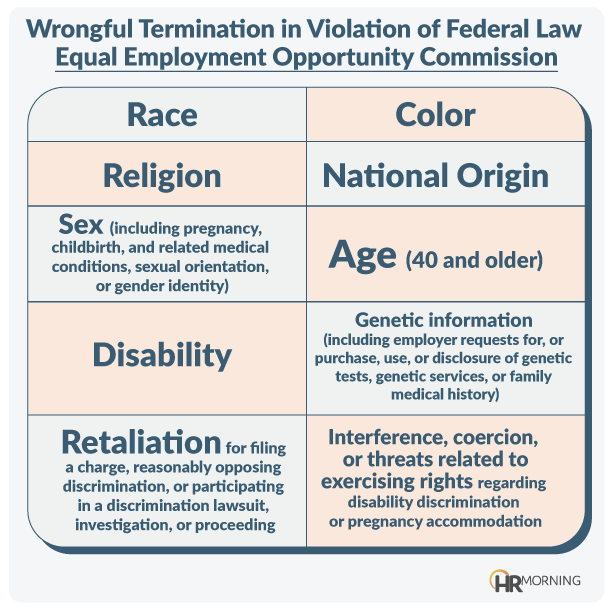
Employees may pursue a wrongful termination lawsuit when they are discharged in violation of federal or state laws, including Title VII of the Civil Rights Act, the Americans with Disabilities Act (ADA), and the Age Discrimination in Employment Act (ADEA). Discrimination based on race, color, religion, sex, national origin, disability, or age over 40 can constitute wrongful termination.
Additionally, firings that retaliate against employees for whistleblowing, filing a workers' compensation claim, or taking legally protected leave under the Family and Medical Leave Act (FMLA) are often deemed unlawful.
 Does at will employment go both ways
Breach of an implied or written employment contract—such as being fired despite promises of job security or not following disciplinary procedures—also serves as a valid legal basis. Each of these grounds requires clear evidence linking the termination to the prohibited action or protected status.
Employer Defenses Against Wrongful Termination Allegations
Employers facing wrongful termination allegations often assert legitimate, non-discriminatory reasons for the employee's dismissal, such as poor performance, violation of company policies, or workforce reduction.
To defend against the claim, the employer must demonstrate that the termination decision was part of routine business operations and applied consistently across the organization. Courts typically uphold terminations when employers maintain documented performance reviews, disciplinary records, and clear termination procedures.
Furthermore, if the employee was employed at-will and no contractual or statutory exceptions apply, the employer’s decision may be legally protected. However, if the employee can show that the stated reason is a pretext for discrimination or retaliation, the defense may be weakened.
 At will clause for employment
Steps to Take When Filing a Wrongful Termination Lawsuit
Before initiating legal action, employees should gather relevant documentation such as employment contracts, performance evaluations, emails, and records of prior complaints. The next critical step is to file a complaint with the Equal Employment Opportunity Commission (EEOC) or a comparable state agency, as this is typically a prerequisite to pursuing a lawsuit.
After receiving a Right to Sue letter, the employee may proceed with filing a civil claim in court. Legal timelines, known as statutes of limitations, vary by jurisdiction and claim type—ranging from 180 to 300 days for federal claims.
Consulting an employment law attorney early in the process increases the likelihood of building a strong case. Properly navigating administrative procedures and meeting all filing deadlines are essential to preserving the employee’s legal rights.
| Key Element | Description | Examples |
|---|---|---|
| Protected Activity | Actions that legally shield employees from retaliation | Filing a discrimination complaint, reporting safety violations, requesting FMLA leave |
| Discrimination | Termination based on a legally protected characteristic | Discharge due to race, gender, pregnancy, disability, religion |
| Breach of Contract | Violation of written or implied employment agreements | Being fired before the end of a contract term or without following disciplinary steps promised |
| Retaliation | Punishing an employee for exercising legal rights | Firing after a worker complains about wage theft or sexual harassment |
| Documentation | Crucial evidence to support a claim | Performance reviews, termination letter, internal communications, witness statements |
Understanding Wrongful Termination Lawsuits: A Comprehensive Legal Guide
What factors influence the success rate of wrongful termination lawsuits?
 Sample at will employment contract
Legal Grounds and Statutory Protections
The foundation of any wrongful termination lawsuit largely depends on whether the employee can demonstrate that the firing violated specific legal protections. In the United States, most employees are considered at-will, meaning they can be terminated for any reason or no reason at all, as long as it is not illegal. However, exceptions exist when terminations violate federal, state, or local laws.
Employees who can prove their discharge was due to discrimination based on protected characteristics such as race, gender, age, disability, religion, or national origin have stronger cases under statutes like Title VII of the Civil Rights Act, the Americans with Disabilities Act (ADA), or the Age Discrimination in Employment Act (ADEA). Additionally, retaliation for engaging in legally protected activities—such as filing a workers’ compensation claim, reporting harassment, or whistleblowing—can serve as valid grounds for a claim.
- Violation of anti-discrimination laws is one of the most common justifications for a successful wrongful termination suit, especially when there is documented evidence of biased remarks, differential treatment, or sudden adverse action after disclosing a protected status.
- Retaliation claims often hinge on timing; for example, being fired shortly after filing a workplace safety complaint with OSHA or refusing to follow an illegal directive can indicate a causal connection between the protected action and termination.
- Employees working under an explicit or implied contract—such as those outlined in an employee handbook or verbal assurances of job security—may argue that termination breached the terms of that contract, providing another legal pathway to challenge the dismissal.
Quality and Availability of Evidence
The strength of a wrongful termination case is significantly influenced by the availability, relevance, and credibility of supporting evidence.
Courts rely heavily on tangible documentation, such as performance reviews, email correspondence, personnel files, and recorded conversations, to assess whether the employer’s stated reason for termination was legitimate or a pretext for unlawful motives. Without solid evidence, even valid legal claims may fail due to lack of substantiation.
Plaintiffs who maintain consistent records of incidents, discriminatory comments, or inconsistencies in the employer’s explanations are at a distinct advantage. Moreover, witness testimony from colleagues who observed unfair treatment can further bolster the claim, especially in cases involving harassment or retaliation.
- Documented performance evaluations that show a history of positive feedback can undermine an employer’s claim that the termination was due to poor performance, especially if the negative review emerged only shortly before dismissal.
- Electronic communications, such as emails or text messages where a manager makes discriminatory statements or admits to retaliatory intent, are often critical in establishing motive and proving the illegality of the termination.
- Employers who deviate from their own established disciplinary procedures—such as skipping performance improvement plans or bypassing HR protocols—can inadvertently provide evidence of inconsistency, suggesting discriminatory or retaliatory conduct.
Jurisdiction and Applicable Labor Laws
The geographic location of the employment and the governing legal framework play a pivotal role in determining the outcome of wrongful termination lawsuits. Federal laws set baseline protections, but individual states may offer broader rights and remedies.
For instance, some states recognize additional public policy exceptions to at-will employment, allowing claims when employees are fired for actions like serving on a jury or seeking minimum wage. Statutes of limitations also vary by jurisdiction, affecting how long an employee has to file a claim.
In addition, certain states require mandatory arbitration for employment disputes, which can limit access to court and reduce the likelihood of favorable outcomes for employees. The nature of the employer—whether a private company, public entity, or government agency—also determines which laws apply and what procedural steps must be followed before litigation.
- States like California and New York are known for robust employee protections, including extended statutes of limitations and strong anti-retaliation provisions, which can increase the success rate of claims compared to states with more employer-friendly laws.
- Public employees may have greater recourse under constitutional protections, such as due process rights, particularly when termination occurs without a hearing or violates First Amendment rights related to speech on matters of public concern.
- The existence of mandatory arbitration agreements in an employment contract can significantly reduce the chances of success in court, as many arbitration processes favor employers through confidential proceedings and limited appeal options.
What are some notable examples of successful wrongful termination lawsuits?
High-Profile Wrongful Termination Cases in Corporate America
- One of the most widely recognized cases involved Peter v. Nortek Inc., where the plaintiff claimed he was wrongfully terminated after refusing to engage in unethical financial reporting practices. The jury awarded him over $5.5 million in damages, emphasizing the legal protection given to employees who report or resist corporate misconduct.
- In another significant case, a senior executive at a major pharmaceutical company was fired shortly after raising concerns about off-label drug marketing. The subsequent lawsuit resulted in a multimillion-dollar settlement, reinforcing the importance of whistleblower protections under federal and state laws.
- A tech industry whistleblower at a Silicon Valley firm exposed data privacy violations and was subsequently let go. Courts ruled in favor of the employee, citing retaliation as the motive, and awarded substantial compensatory and punitive damages, setting a precedent in the tech sector regarding ethical accountability and job protection.
Discrimination-Based Wrongful Termination Lawsuits
- A landmark case involved a female executive at a financial institution who was terminated after returning from maternity leave. The court found clear evidence of gender discrimination and awarded her $2.7 million, highlighting protections under Title VII of the Civil Rights Act.
- In a racial discrimination case, a long-time employee at a manufacturing plant was fired under dubious performance claims shortly after filing a complaint about racially insensitive remarks. The jury determined the termination was retaliatory and racially motivated, awarding over $3 million in damages.
- An older worker in the retail sector was laid off during a restructuring, but evidence showed that younger employees with similar or worse performance records were retained. The Age Discrimination in Employment Act (ADEA) was central to the case, and the plaintiff secured a favorable settlement that included back pay and emotional distress compensation.
- An aerospace engineer was fired weeks after reporting safety violations to federal regulators. The U.S. Department of Labor intervened, and the case was settled with reinstatement, back pay, and a sizable financial award, underscoring federal protections for employees in safety-sensitive industries.
- A nurse in a public hospital reported unsafe patient care practices and was subsequently demoted and then terminated. State and federal whistleblower laws were invoked, leading to a successful lawsuit that included compensation for lost wages and reputational harm.
- A government contractor employee disclosed fraudulent billing practices to internal audit teams and was let go on performance grounds shortly thereafter. The court determined this was retaliatory, citing the False Claims Act, and awarded damages that included legal fees and front pay until the plaintiff could secure comparable employment.
What are your legal options if you’ve been wrongfully terminated from your job?
Understanding What Constitutes Wrongful Termination
- Wrongful termination occurs when an employee is fired in violation of employment laws, company policies, or an employment contract. While at-will employment allows employers to terminate employees for any reason, certain exceptions apply that can transform a termination into a wrongful one.
- Common examples of wrongful termination include being fired due to discrimination based on race, gender, age, religion, disability, or sexual orientation. Retaliation for reporting illegal activities, filing a workers' compensation claim, or taking legally protected leave (such as under the Family and Medical Leave Act) also qualifies as wrongful termination.
- Additionally, if an employee has an employment contract guaranteeing job security for a specific period, termination without just cause may be considered a breach of contract. Violating public policy—such as firing someone for refusing to engage in illegal acts—is another recognized form of wrongful discharge.
Steps to Take Immediately After Being Wrongfully Terminated
- Begin by gathering all relevant documentation, including your employment contract, company handbook, performance reviews, pay stubs, and any written communication regarding your termination. This evidence can support your claim and help establish patterns of unfair treatment.
- Contact your state’s labor department or the U.S. Equal Employment Opportunity Commission (EEOC) to file a formal complaint. Many claims require administrative filing before you can pursue a lawsuit, and there are strict deadlines—typically 180 days, extendable to 300 days in some states.
- Consult with an employment attorney who specializes in wrongful termination cases. They can help assess the strength of your claim, guide you through legal procedures, and represent you in negotiations or court if necessary. Avoid signing any severance agreements without legal advice, as they may limit your ability to pursue claims.
Potential Legal Remedies and Compensation Available
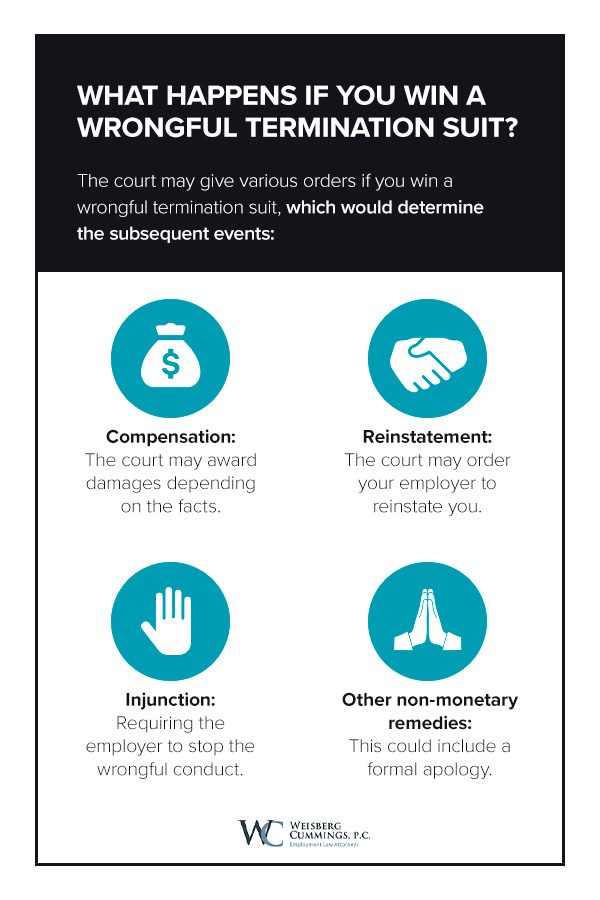
- If your wrongful termination claim is successful, you may be entitled to reinstatement, meaning you get your job back. This remedy is less common but possible, especially if no hostile work environment remains and the employer is willing or legally compelled to rehire you.
- Back pay and front pay are common financial remedies. Back pay compensates for lost wages from the time of termination to the resolution of your case. Front pay covers expected future earnings if reinstatement is not feasible.
- Additional compensation may include emotional distress damages, punitive damages (in cases of egregious misconduct by the employer), and attorney’s fees. In some cases, employers may also face fines or be required to implement policy changes to prevent future violations.
Frequently Asked Questions
What is a wrongful termination lawsuit?
A wrongful termination lawsuit occurs when an employee is fired in violation of employment laws, contracts, or public policy. This may include being dismissed due to discrimination, retaliation for reporting illegal activity, or in breach of an employment agreement. Employees who believe they were fired under unjust or illegal circumstances may file this type of claim to seek compensation or reinstatement through the court system.
How do I know if I have a valid wrongful termination claim?
You may have a valid claim if your firing involved discrimination based on race, gender, religion, age, or disability, or if it violated company policy, an employment contract, or labor laws. Retaliation for whistleblowing or exercising legal rights—like filing a workers’ compensation claim—also qualifies. Documenting the circumstances and consulting an employment attorney can help determine the strength of your case.
What damages can I recover in a wrongful termination lawsuit?
In a wrongful termination lawsuit, you may recover back pay for lost wages, future lost earnings, emotional distress damages, and attorney fees. If the termination involved serious misconduct, such as discrimination or retaliation, you might also receive punitive damages. Some cases result in reinstatement to the former job. The exact compensation depends on the facts and jurisdiction, so legal advice is essential.
How long do I have to file a wrongful termination lawsuit?
The time limit, or statute of limitations, varies by state and claim type but typically ranges from 180 days to 3 years. For federal claims like discrimination, you usually must file a charge with the EEOC within 180 to 300 days before suing. It’s crucial to act quickly and consult an attorney to ensure you meet all necessary deadlines for filing your lawsuit.
Leave a Reply