
Osha standards for stairs
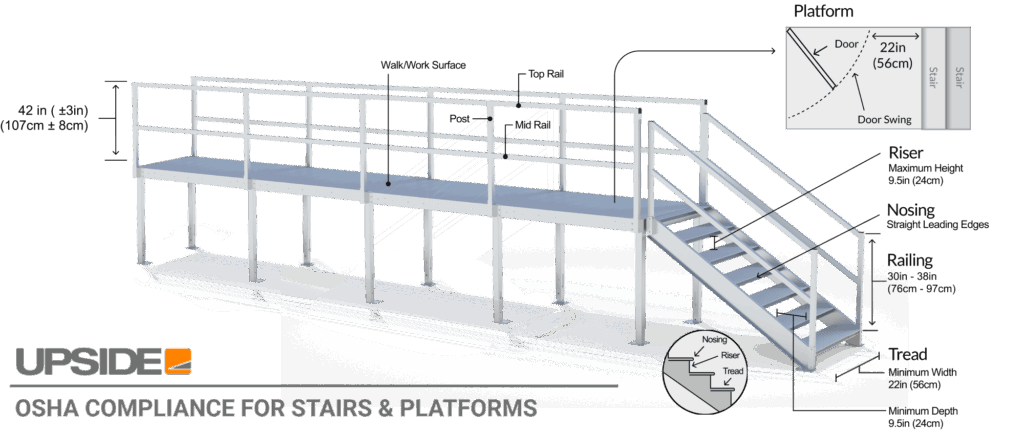
Stair safety is a critical component of workplace design, and the Occupational Safety and Health Administration (OSHA) has established clear standards to minimize the risk of falls and injuries.
OSHA's regulations for stairs address key aspects such as dimensions, handrails, stair treads, and general construction requirements. These standards apply to fixed stairs used in industrial, commercial, and construction settings, ensuring safe access between different levels.
Compliance helps prevent accidents, promotes worker well-being, and reduces liability for employers. Understanding and implementing OSHA's stair guidelines is essential for maintaining a safe and compliant work environment across various industries.
 Racial discrimination poster
OSHA Standards for Stairs: Ensuring Safety in the Workplace
The Occupational Safety and Health Administration (OSHA) has established comprehensive standards for stairs to prevent falls and ensure safe passage in the workplace. These standards apply to various types of stairs, including fixed stairs, portable stairs, and temporary stairways used during construction.
OSHA's regulations, primarily found in 29 CFR 1910.24 through 1910.28 and 29 CFR 1926.1050 through 1926.1054 in the construction industry, specify detailed requirements for stair design, construction, and usage.
The overarching goal is to minimize the risk of accidents caused by inadequate stair design, poor lighting, or the absence of protective features such as handrails and guardrails. Compliance with OSHA stairs standards not only helps avoid citations and penalties but also significantly enhances worker safety and reduces the likelihood of costly injuries.
Design and Construction Requirements for Fixed Stairs
OSHA mandates specific dimensional and structural criteria for fixed stairs to ensure they are safe and usable under normal working conditions. According to 29 CFR 1910.24, stairs must have uniform rise and run dimensions, with a minimum tread depth of 9.5 inches and a maximum riser height of 9.5 inches.
 Racial discrimination solicitors
The stairway must support a minimum live load of 100 pounds per square foot, and it should be installed at an angle between 30 and 50 degrees from the horizontal. Additionally, landings must be provided where stairs change direction, and these landings should be at the same level as the landing served.
Stair treads must be slip-resistant, and when located where they could be exposed to flammable or corrosive substances, they must be constructed of non-combustible, corrosion-resistant materials. These dimensional and material specifications help ensure long-term durability and user safety.
Guardrails and Handrail Requirements
One of the most critical components of OSHA-compliant stairways is the presence of guardrails and handrails to prevent falls from elevated surfaces. OSHA requires that stairways with four or more risers or rising more than 30 inches must have at least one handrail and guardrails on open sides.
Handrails must be mounted between 30 and 37 inches above the leading edge of the tread and must be graspable, with a diameter that allows a secure grip (typically 1.25 to 2 inches).
 Racial discrimination solution
Guardrails must have a top rail at 42 inches (±3 inches) high, an optional intermediate rail (midrail), and must withstand a force of at least 200 pounds applied in any downward or outward direction. These protective systems are essential in both industrial and construction environments, especially where workers carry tools or materials, increasing balance challenges on stairs.
Temporary and Portable Stair Requirements in Construction
In construction settings, temporary and portable stairs are commonly used during building phases before permanent stair systems are installed. OSHA’s construction standards (29 CFR 1926.1053 and 1926.1054) provide specific rules for these systems.
Temporary stairs must be capable of supporting at least five times the maximum intended load, and they must have uniform riser heights and tread depths. Each step must have a minimum tread depth of 9.5 inches and a maximum riser height of 9.5 inches, consistent with permanent stair standards.
Unlike permanent systems, temporary stairs may use platforms or landings constructed of materials such as plywood over framing, but all such surfaces must be slip-resistant and free of tripping hazards. Moreover, all temporary stairs must have handrails on at least one side if they have two or more risers. These provisions ensure that workers have safe access and egress even during early construction stages.
| OSHA Requirement | Specification | Applicable Stair Type |
|---|---|---|
| Riser Height | Maximum of 9.5 inches | Fixed, temporary, and portable stairs |
| Tread Depth | Minimum of 9.5 inches | Fixed, temporary, and portable stairs |
| Stair Angle | Between 30 and 50 degrees from horizontal | Fixed stairs |
| Handrail Height | 30 to 37 inches above tread | All stairs with 4+ risers or >30 rise |
| Guardrail Height | 42 inches (±3 inches) top rail | Open-sided stairways |
| Load Capacity | 100 psf for fixed; 5x intended load for temporary | Fixed and temporary stairs |
OSHA Standards for Stairs: A Comprehensive Guide to Compliance and Safety

Lack of Handrails or Improper Handrail Installation
One of the most frequent OSHA violations related to stair safety involves missing or improperly installed handrails. Stairways with four or more risers—or that rise more than 30 inches—must have at least one handrail, according to OSHA standard 1910.23(e)(1).
When handrails are present but incorrectly installed, they can be just as hazardous as having none at all. Common issues include incorrect height, loose mounting, or placement that doesn’t allow for a continuous grasp while ascending or descending. Workers relying on these handrails for balance may lose support, increasing the risk of falls and serious injuries.
- Handrails must be installed between 30 and 37 inches above the leading edge of the stair tread to ensure proper ergonomics and accessibility.
- They must be continuous along the full length of the stair flight to provide uninterrupted support.
- OSHA requires that handrails be capable of withstanding a load of at least 200 pounds applied in any downward or outward direction at any point.
Inadequate Stairway Tread Depth, Riser Height, or Uniformity
Another major OSHA violation concerns inconsistent or non-compliant stair dimensions, including tread depth, riser height, and overall uniformity. Stairways must have uniform risers and treads to prevent tripping hazards.
OSHA regulation 1910.24(b) mandates that the minimum tread depth be 9.5 inches (measured from riser to riser), and riser height must not exceed 9.5 inches. When these dimensions vary from step to step—or when construction shortcuts lead to non-standard stairs—workers are at a higher risk of missteps and falls. Temporary or makeshift stairs on construction sites are particularly prone to this violation.
- Each step on a staircase must have consistent tread depth and riser height, with variations between steps not exceeding 1/4 inch.
- Open risers are permitted only if the opening is less than 10 inches to prevent foot passage and tripping.
- On spiral stairs, treads must be at least 7.5 inches wide at a point 12 inches from the inside of the handrail to ensure safe footing.
Poor Maintenance or Obstructed Stairways
OSHA routinely cites workplaces for failing to maintain stairways in safe, usable condition or for allowing them to become obstructed. According to 1910.23(a)(2), stairways must be kept free of hazardous materials, debris, tools, or any other obstruction that could lead to slips, trips, or falls.
In industrial or construction environments, it’s common to see materials stored on landings or tools left on steps, creating unsafe passage. Additionally, worn treads, damaged noses, or slippery surfaces without appropriate slip-resistant features contribute to preventable accidents.
- Stairways must be inspected regularly to identify and correct signs of wear, oil accumulation, or structural damage.
- Obstructions such as cords, equipment, or storage items should never be placed on stairs or landings, which are designated for egress only.
- Slip-resistant surfaces or coatings should be applied where water, grease, or other contaminants may come into contact with treads.
Frequently Asked Questions
What are the OSHA requirements for stair tread depth?
OSHA requires that stair treads have a minimum depth of 9.5 inches (24 cm) measured from the leading edge of one tread to the leading edge of the next. This ensures adequate foot placement and reduces the risk of slips and falls. Treads must be evenly spaced and slip-resistant. Variations in tread depth between steps should not exceed 1/4 inch to maintain consistency and safety throughout the staircase.
What is the maximum OSHA-approved rise height for stairs?
OSHA specifies that the vertical rise of each step must be no more than 9.5 inches (24 cm), with no variation greater than 1/4 inch between steps. Uniform rise height is critical for user predictability and balance. A consistent rise across all steps helps prevent missteps and accidents. Stairways must be designed and constructed with this specification to ensure safe and reliable use in the workplace.
When does OSHA require handrails on stairways?
OSHA requires handrails on stairways with four or more risers (three or more treads). Handrails must be installed on at least one side of the stair and be easily graspable. They must be placed between 30 and 37 inches above the tread nosing. Handrails provide stability and support, significantly reducing fall risks, especially on longer or steeper staircases commonly found in industrial and construction settings.
What are OSHA's standards for stairway width and clearance?
OSHA mandates that stairways be at least 22 inches wide, with a minimum headroom of 7 feet. This ensures enough space for safe passage and emergency egress. Obstructions must be avoided to maintain clear access. These dimensions help accommodate most workers and equipment while preventing collisions and facilitating movement, especially in high-traffic or hazardous work environments where quick evacuation may be necessary.
Leave a Reply