
What is the osha standard

The Occupational Safety and Health Administration (OSHA) sets federal standards to ensure safe and healthful working conditions across the United States.
OSHA standards are rules that employers must follow to protect workers from hazards on the job, including exposure to dangerous chemicals, unsafe machinery, and poor working environments. These regulations cover various industries, from construction to healthcare, and address issues like fall protection, electrical safety, and hazardous material handling.
Compliance with OSHA standards not only minimizes workplace injuries and fatalities but also promotes a culture of safety. Employers are required to provide training, maintain records, and implement safety procedures in accordance with OSHA guidelines.
 All forms of racial discrimination
What Is the OSHA Standard?
The Occupational Safety and Health Administration (OSHA) standards are a set of federally enforceable regulations established to ensure safe and healthy working conditions for employees across the United States. These standards, issued under the authority of the Occupational Safety and Health Act of 1970, apply to most private sector employers and workers, as well as some public sector employers.
OSHA standards cover a wide range of workplace hazards, including those in construction, general industry, maritime operations, and agriculture. These regulations specify requirements for everything from exposure to hazardous chemicals and machinery safety to fall protection and workplace sanitation.
Employers are legally obligated to comply with applicable OSHA standards and must provide a workplace free from recognized hazards that could cause death or serious physical harm. Compliance is monitored through inspections, citations, and penalties for violations, reinforcing a national framework of worker protection and accountability.
Key Categories of OSHA Standards
OSHA standards are organized into several major categories, each targeting specific industries and types of hazards.
 Amazon racial discrimination
The four primary regulatory areas are General Industry (29 CFR 1910), Construction (29 CFR 1926), Maritime (29 CFR 1915–1919), and Agriculture (29 CFR 1928). General Industry standards apply to the broadest range of workers and workplaces, including manufacturing, healthcare, and warehousing.
Construction standards focus on high-risk activities such as scaffolding, trenching, and electrical work, where fall hazards and structural instability are common. Maritime regulations address shipyard, marine terminal, and longshoring operations, addressing unique risks like equipment handling and confined space entry.
Agricultural standards cover field operations, machinery safety, and exposure to environmental extremes. Each category contains detailed rules designed to prevent injuries, illnesses, and fatalities in high-risk work environments.
Enforcement and Compliance Mechanisms
OSHA ensures compliance with its standards through a combination of inspections, penalties, and outreach initiatives. The agency conducts both planned and unannounced inspections in response to complaints, accidents, or targeted programs in high-hazard industries.
 Amendment against racial discrimination
Inspectors, known as compliance officers, evaluate workplaces for adherence to safety and health regulations, often reviewing records, interviewing employees, and checking equipment. When violations are found, OSHA may issue citations accompanied by fines that vary in severity based on the nature of the violation—ranging from de minimis to willful or repeated infractions.
Employers have the right to contest citations, but must generally correct hazards within a specified timeframe. Beyond enforcement, OSHA supports compliance through training programs, consultation services, and educational resources, helping employers proactively meet standards and foster a culture of safety.
Employer Responsibilities Under OSHA Standards
Under OSHA regulations, employers are required to fulfill several key responsibilities to safeguard their workforce. They must provide a workplace that is free from serious recognized hazards and comply with all applicable OSHA standards, rules, and regulations.
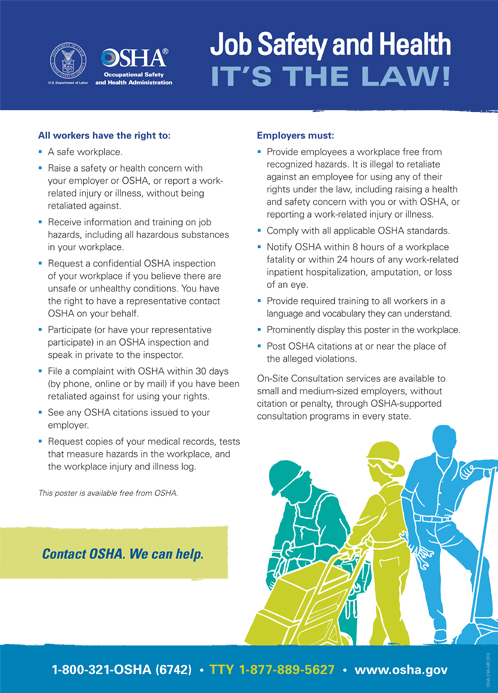
This includes supplying necessary personal protective equipment (PPE) at no cost to employees, implementing safety training in a language workers understand, and maintaining accurate records of work-related injuries and illnesses using forms such as OSHA 300, 300-A, and 301. Employers must also display the official OSHA Job Safety and Health poster to inform employees of their rights and responsibilities.
In addition, they are prohibited from retaliating against workers who report injuries, file complaints, or participate in OSHA investigations. These responsibilities form a legal and ethical foundation for promoting workplace safety, transparency, and employee empowerment.
| OSHA Standard Area | Key Requirements | Common Hazards Addressed |
|---|---|---|
| General Industry (1910) | Chemical exposure limits, machine guarding, hazard communication, lockout/tagout | Toxic substances, moving machinery, electrical risks |
| Construction (1926) | Fall protection, scaffolding safety, trenching standards, head/eye protection | Height-related falls, collapsing trenches, falling objects |
| Maritime (1915–1919) | Confined space entry, shipbreaking procedures, rigging safety | Drowning risks, atmospheric hazards, heavy lifting accidents |
| Agriculture (1928) | Tractor rollover protection, youth employment restrictions, grain bin safety | Entanglement in machinery, suffocation, exposure to pesticides |
What Is the OSHA Standard: A Comprehensive Guide
What is the OSHA general duty standard and its importance in workplace safety?
Definition and Scope of the OSHA General Duty Clause
- The OSHA General Duty Clause, found in Section 5(a)(1) of the Occupational Safety and Health Act of 1970, requires employers to provide a workplace free from recognized hazards that are causing or are likely to cause death or serious physical harm to employees.
- This clause applies to all employers covered by OSHA, even in situations where there is no specific OSHA standard addressing a particular hazard. It serves as a broad safety mandate that fills gaps when detailed regulations do not exist.
- The General Duty Clause is enforced by OSHA inspectors who can issue citations if they determine that a serious hazard is present, the employer knew or should have known about it, and feasible methods exist to eliminate or reduce the hazard.
Key Elements Required for a General Duty Clause Violation
- For OSHA to cite an employer under the General Duty Clause, four main elements must be proven: a hazard must exist that is recognized either within the industry or through general knowledge, and it must be likely to cause serious harm or death.
- The employer must have known, or reasonably should have known, about the hazard through training, observation, or industry standards. This includes situations where the hazard was obvious or had been previously reported.
- There must be a feasible means available to correct the hazard—this means practical solutions that are technologically and economically possible for the employer to implement without excessive difficulty.
Importance of the General Duty Clause in Workplace Safety
- The General Duty Clause plays a critical role in maintaining safe work environments by holding employers accountable for hazards, even when no specific regulation covers them, thus ensuring a baseline level of protection for workers.
- It encourages proactive safety management, prompting employers to continuously assess their workplaces for emerging or non-standardized risks such as ergonomic issues, workplace violence, or heat stress.
- By allowing OSHA to take action in the absence of a specific standard, the clause adapts to evolving workplace conditions and technologies, making it an essential tool in advancing occupational safety and health across all industries.
Frequently Asked Questions
What is the OSHA standard?
OSHA standards are federal regulations established to ensure safe and healthful working conditions for employees in the United States. These standards cover various industries and address hazards such as fall protection, exposure to toxic chemicals, and proper machine guarding. They are created through rulemaking procedures and enforced by the Occupational Safety and Health Administration. Employers must comply with these standards to prevent workplace injuries, illnesses, and fatalities.
Why are OSHA standards important?
OSHA standards are crucial because they protect workers from serious hazards on the job. They help reduce workplace injuries, illnesses, and fatalities by setting clear safety and health requirements. Employers who follow OSHA standards create safer work environments, which can increase productivity and reduce costs related to accidents. Additionally, compliance helps avoid penalties and legal issues, ensuring businesses operate responsibly and ethically in protecting employee well-being.
How are OSHA standards developed?
OSHA standards are developed through a formal rulemaking process that includes research, public hearings, and input from industry experts, labor groups, and the public. OSHA proposes a new standard, publishes it in the Federal Register, and allows time for comments. After reviewing feedback, OSHA may revise the proposal before issuing the final rule. This thorough process ensures that standards are scientifically sound, practical, and effective in improving workplace safety and health.
Where can I find OSHA standards?
OSHA standards are available on the official OSHA website (www.osha.gov) in the Standards section. They are organized by industry, including General Industry, Construction, Maritime, and Agriculture. The electronic Code of Federal Regulations (e-CFR) also provides up-to-date versions of all OSHA regulations. Additionally, printed materials and guidance documents are available through OSHA’s regional offices or its outreach programs to help employers and workers understand and comply with the standards.
Leave a Reply