
Osha lightning standards 1910
The Occupational Safety and Health Administration (OSHA) lightning standards under 29 CFR 1910 provide critical guidelines to protect workers from the dangers of lightning in outdoor and industrial environments.
These regulations address risks associated with working at heights, near conductive materials, and during adverse weather conditions. Employers are required to implement safety protocols, including monitoring weather forecasts, establishing emergency procedures, and training employees on hazard recognition.
Though OSHA does not have a specific standard exclusively for lightning, relevant provisions in the General Industry Standards help mitigate risks. Compliance ensures workplace safety and reduces the likelihood of injuries or fatalities during thunderstorms.
 Anti racial discrimination
Understanding OSHA Lightning Safety Standards in 29 CFR 1910
The Occupational Safety and Health Administration (OSHA) does not have a specific standard solely dedicated to lightning safety within its 29 Code of Federal Regulations (CFR) Part 1910, which covers general industry standards.
However, lightning-related hazards are addressed under OSHA’s General Duty Clause and various related standards designed to protect workers from electrical hazards and outdoor environmental risks.
Employers are required to recognize and mitigate the dangers associated with lightning, especially for workers in outdoor industries such as construction, agriculture, utility services, and telecommunications.
Guidance from other authoritative sources like the National Weather Service (NWS) and the National Oceanic and Atmospheric Administration (NOAA) plays a complementary role in shaping workplace lightning safety policies that align with OSHA’s overarching safety requirements.
 Asian racial discrimination
OSHA’s General Duty Clause and Lightning Protection
Under Section 5(a)(1) of the Occupational Safety and Health Act—the General Duty Clause—employers are obligated to provide a workplace free from recognized hazards that are likely to cause death or serious physical harm, including those posed by lightning strikes.
Although there is no specific regulation labeled OSHA lightning standard 1910, this clause empowers OSHA to cite employers who fail to act against known risks, such as continuing outdoor operations during thunderstorm activity.
Employers must establish lightning safety protocols, including monitoring weather conditions, providing timely warnings, and designating safe shelters. Violations may be issued if a hazard is identifiable, a feasible solution exists, and the employer fails to act reasonably to prevent exposure.
Relevant Electrical and Environmental Standards in 29 CFR 1910
While there is no standalone lightning standard, several sections within 29 CFR 1910 indirectly cover lightning-related safety. For example, Subpart K (Electrical) outlines requirements for electrical system design and protection, which can apply to lightning-induced surges in industrial equipment.
 At&t racial discrimination lawsuit
Similarly, standards related to personal protective equipment (PPE) and workplace safety during adverse weather conditions support employee protection from secondary hazards caused by lightning, such as fires, electrical shocks, or structural damage.
Additionally, OSHA’s requirements for emergency action plans (1910.38) and fire prevention plans (1910.39) may include procedures for weather-related emergencies, effectively encouraging a proactive approach to lightning safety in facilities and outdoor job sites.
Industry Best Practices for Lightning Safety and OSHA Compliance
To meet their obligations under OSHA regulations, employers often adopt industry-recognized best practices for lightning safety, especially in high-risk sectors.
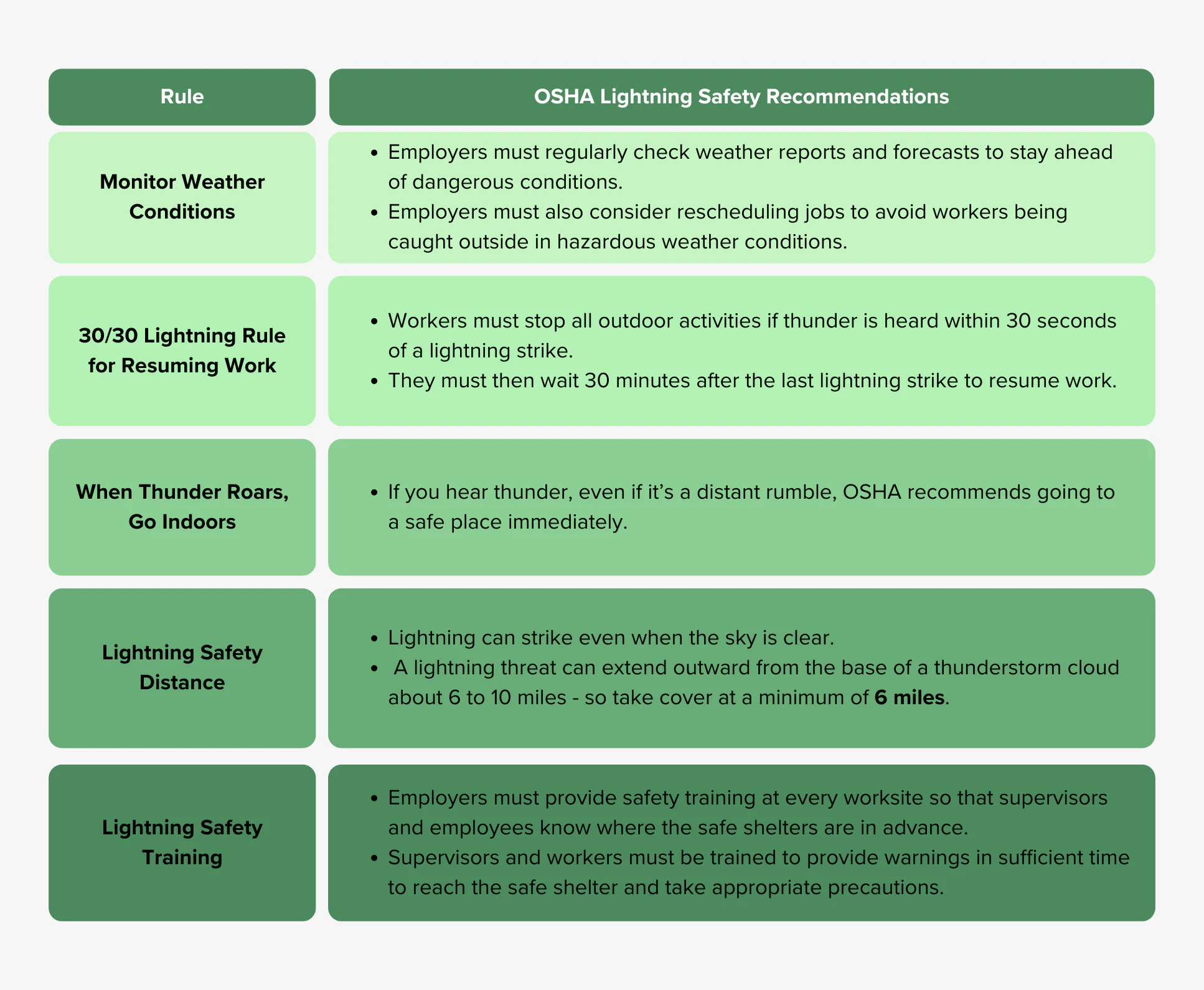
The 30-30 Rule is widely recommended: if the time between lightning flash and thunder is 30 seconds or less (indicating lightning is within six miles), workers should seek shelter, and outdoor activities should resume only 30 minutes after the last observed lightning or thunder.
Employers should designate substantial buildings or fully enclosed metal vehicles as safe shelters and conduct training on lightning risks. Using tools like weather monitoring apps, lightning detection systems, and written safety policies further demonstrates due diligence in complying with OSHA’s broad but effective framework.
| Practice | Description | OSHA Alignment |
|---|---|---|
| Monitoring Weather | Using real-time weather alerts and lightning prediction tools to anticipate storms | Supports compliance with General Duty Clause by identifying hazards |
| Safe Shelters | Designating permanent buildings or enclosed metal vehicles as lightning-safe zones | Fulfills duty to provide protected work environments |
| Employee Training | Educating workers on lightning risks, warning signs, and evacuation procedures | Aligns with emergency preparedness standards (1910.38) |
OSHA Lightning Safety Standards 1910: A Comprehensive Guide to Compliance and Workplace Protection
What does OSHA 1910.303(g) require regarding electrical safety and lightning protection in the workplace?
Electrical Safety Requirements Under OSHA 1910.303(g)
OSHA regulation 1910.303(g) establishes critical requirements to ensure electrical safety in the workplace, particularly focusing on the installation and use of electrical equipment.
This section mandates that all electrical equipment must be used in a manner consistent with its listing and labeling. Employers are required to ensure that electrical systems are carefully evaluated for potential hazards such as fire, electric shock, and arc flash.
The regulation also emphasizes that electrical installations must be suitable for the environment in which they are placed—for example, damp or hazardous locations require equipment specifically designed for those conditions. Compliance involves proper maintenance, preventing contact with live parts, and providing adequate working space around electrical panels.
- Electrical equipment must be installed and used according to its listing and labeled instructions to prevent misuse and ensure operational safety.
- All electrical installations must account for environmental conditions, including wet, corrosive, or explosive atmospheres, by using equipment rated for such environments.
- Adequate workspace must be maintained around electrical panels and equipment to allow safe access and prevent hazards during maintenance or emergencies.
Worker Protection and Hazard Mitigation
OSHA 1910.303(g) places a strong emphasis on protecting employees from electrical hazards by requiring that live parts of electrical equipment operating at 50 volts or more be guarded against accidental contact. Employers must install enclosures, barriers, or covers that prevent unqualified workers from reaching energized components.
The regulation also requires that conductors and equipment be constructed and installed to handle expected electrical loads without overheating. Additionally, preventive measures such as lockout/tagout procedures during maintenance and regular inspections are essential to reduce the risk of exposure to energized circuits.
- Exposed live parts operating at 50 volts or more must be enclosed or guarded to prevent employee contact and reduce shock risk.
- Only qualified persons who have appropriate training and protective equipment may work on energized circuits.
- Appropriate lockout/tagout procedures must be followed when servicing electrical systems to ensure circuits are de-energized and cannot be re-energized accidentally.
Lightning Protection and Grounding Considerations
While OSHA 1910.303(g) does not explicitly outline lightning protection systems, it mandates proper grounding and bonding practices that are crucial components of lightning protection strategies. The regulation requires that electrical systems and equipment be grounded to limit voltage surges and facilitate the operation of overcurrent protection devices.
In environments where lightning strikes are a known risk—such as outdoor operations, tall structures, or areas with high lightning incidence—employers must ensure that buildings and critical equipment are equipped with grounding systems capable of safely dissipating high-voltage transients. Proper grounding helps protect not only equipment but also personnel by minimizing step and touch potentials during lightning events.
- Electrical systems must be grounded according to code requirements to minimize overvoltage from lightning or faults and ensure reliable operation of protective devices.
- Equipment and enclosures must be bonded to maintain electrical continuity and provide a safe path for fault current, reducing fire and shock hazards.
- In high-risk environments, additional lightning protection systems—such as air terminals, down conductors, and ground rods—should be installed in accordance with recognized standards like NFPA 780, even though not explicitly required by OSHA 1910.303(g).
What does OSHA 1910.34 cover regarding lightning safety in the workplace?
OSHA 1910.34 does not specifically address lightning safety in the workplace. Instead, this standard primarily focuses on general requirements for emergency exit routes, including the design, maintenance, and operational standards for exits to ensure safe evacuation during emergencies.
While OSHA 1910.34 supports overall worker safety during emergency situations, it does not include provisions dedicated to lightning protection, storm response, or outdoor safety during thunderstorms.
Employers seeking guidance on lightning safety must refer to other OSHA standards, industry best practices, or resources from organizations like the National Weather Service or the National Fire Protection Association (NFPA).
Understanding the Scope of OSHA 1910.34
- OSHA 1910.34 outlines the minimum requirements for exit routes in the workplace, ensuring they are properly designated, unobstructed, and clearly marked to facilitate rapid and safe evacuation.
- The standard emphasizes the importance of exit route design, including the number of exits required based on occupancy and building size, as well as the need for fire-resistant construction materials in exit enclosures.
- While it prepares workplaces for emergencies such as fires or structural failures, it does not contain specific protocols or guidance for handling weather-related hazards like lightning strikes.
Relevance of Other OSHA Standards to Lightning Safety
- Although 1910.34 does not cover lightning, other parts of OSHA regulations—such as those in construction (1926 Subpart K) or general industry electrical standards (1910.303)—include safety conditions that may indirectly relate to outdoor electrical hazards, including lightning.
- Employers in outdoor industries, such as agriculture, construction, or oil and gas, are expected to follow OSHA’s General Duty Clause, which requires a workplace free from recognized hazards, including those posed by severe weather and lightning.
- OSHA often refers to consensus standards like NFPA 780 (Standard for the Installation of Lightning Protection Systems) to guide employers on recommended lightning protection measures for structures and operations.
Best Practices for Lightning Safety in Absence of Specific OSHA Regulation
- Employers should implement site-specific lightning safety plans, especially for workers in open fields, on elevated structures, or near conductive equipment, by establishing protocols for suspending operations when thunderstorms are imminent.
- Reliable weather monitoring systems and real-time alerts should be integrated into safety programs, allowing supervisors to make timely decisions to evacuate or relocate outdoor personnel.
- Safe shelters during lightning events include fully enclosed buildings with plumbing and wiring or hard-topped metal vehicles; workers should avoid isolated trees, open shelters, or metal fences that could increase the risk of injury.
Frequently Asked Questions
What are OSHA's lightning safety standards under 29 CFR 1910?
OSHA does not have a specific standard solely for lightning under 29 CFR 1910. However, employers must follow the General Duty Clause, which requires a safe workplace free from recognized hazards, including lightning. Industries like construction and agriculture often implement lightning safety protocols. OSHA recommends monitoring weather, establishing evacuation plans, and seeking shelter when thunderstorms are imminent.
Does OSHA require lightning protection systems in workplaces?
OSHA does not explicitly mandate lightning protection systems in all workplaces but references NFPA 780 for guidance on installation. Employers in high-risk environments, such as outdoor operations or tall structures, are encouraged to install lightning rods and grounding systems. Compliance with recognized standards helps meet OSHA’s General Duty Clause by reducing the risk of injury or damage from lightning strikes in the workplace.
How should employers protect outdoor workers from lightning under OSHA guidelines?
Employers must protect outdoor workers by monitoring weather conditions and having a lightning safety plan. When thunder is heard, workers should immediately move to enclosed buildings or hard-topped vehicles. Activities should resume only 30 minutes after the last thunderclap. Training, emergency procedures, and designated safe shelters are key components of a compliant safety program under OSHA’s General Duty Clause for lightning-related hazards.
Can OSHA cite employers for not having a lightning safety plan?
Yes, OSHA can cite employers under the General Duty Clause if they fail to address known lightning hazards, especially in high-risk industries. If an injury occurs and no safety plan is in place, OSHA may determine the employer did not provide a safe workplace. Employers are expected to recognize severe weather risks and implement actionable plans, including evacuation and communication procedures, to protect employees from lightning danger.
Leave a Reply